
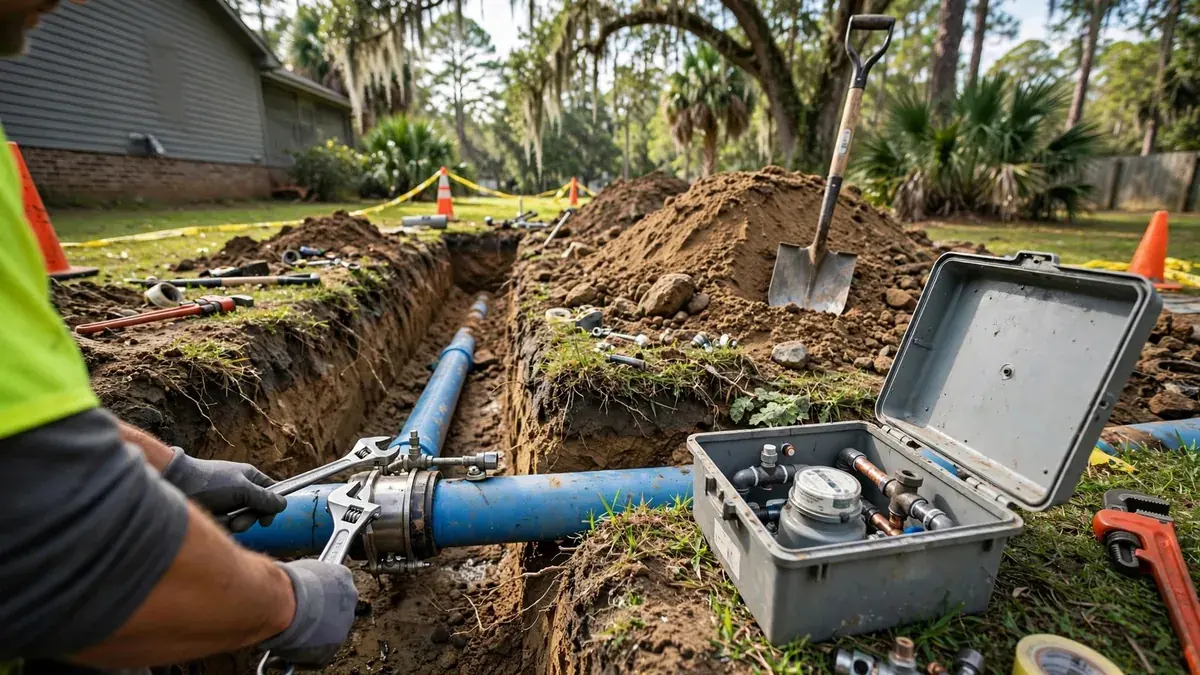
Emergency Water Line Repair in Canton, MA
- 24/7 dispatch
- Street-to-house service lines
- Clear price before work starts
- Licensed and insured
When the taps go dry or the pressure falls on every fixture at once, the problem is often the service line, the buried pipe that carries water from the street to your Canton, MA house. Our 24/7 dispatch handles that call, and a licensed plumber can be sent while you check the simple things below.
Emergency water line repair means finding the break in that buried pipe, shutting the water off safely and repairing or replacing the failed section. The first job is working out whether the failure is on your side of the meter or the town's.
No water, low pressure or a wet yard: what each symptom tells a plumber
| What you notice | What it usually means | What happens next |
|---|---|---|
| No water at any tap | Closed or failed valve, a shutoff by the town, or a broken service line | Check the main valve and ask neighbors, then call |
| Weak flow at every fixture | A leak on the service line, a partly closed valve or a clogged pressure reducer | Compare cold and hot, then test at the meter |
| Soggy patch, no rain | Leak on the buried line, or a sprinkler fault | Close the main, check the meter, locate the leak |
| Meter moves, house is off | Leak between meter and house, or inside the house | Close the main and recheck the dial |
Finding a broken service line before you dig up the lawn
The pipe from the street runs underground, often through a foundation wall into the basement. When it leaks, the water takes the easiest path, which may be up to the surface near the house, down the outside of a foundation wall or along the pipe trench toward the street. That is why the wet spot is not always above the break.
A plumber starts at the meter. With every fixture off, a moving dial and a closed main valve that stops it tells you the leak is inside the house. If the dial keeps moving with the main closed, the break is on the buried line. Ground microphones then listen for the hiss along the route, and a locator traces the pipe so the trench is as short as possible.
Spot repair or replace the whole line?
Once the break is found, the real decision is how much pipe to deal with. A good plumber shows you the pipe condition and lets you choose.
A spot repair fits when
- The pipe is sound on both sides of the break
- A single failure was caused by one event, like a dig
- The line is short and the trench is easy to reach
- You plan to sell or renovate soon
Replacement fits when
- The pipe has failed before or is corroded
- The line is long, and one repair means a second dig soon
- Water is discolored or pressure has been poor for years
- The material is one you are told needs replacing
Water gushing at the street side or into the yard: do this before the plumber arrives
Close your main valve
Turn it fully in the basement or utility area. If water keeps flowing in the yard after it is closed, the break is ahead of your valve and the town's shutoff may be needed.
Do not dig yourself
Underground utilities share the same yard, and a shovel through a gas or electric line is far worse than a leak. Leave digging to the plumber after the utilities are marked.
Call dispatch and the town
Tell dispatch the pipe is leaking outside, and report water at the street or meter to the Canton Water/Sewer Division so it can respond to its side.
Low water pressure: service line, valve or something else
A drop in pressure that hits every tap, hot and cold, points upstream of your water heater. Candidates include a partly closed main valve (a gate valve can fail internally), a pressure reducer on its way out, a corroded service line or a leak that is bleeding off pressure before the water reaches the house.
Low pressure on hot water only is a heater problem, and at a single fixture it is almost always the fixture. Before any dig, a plumber checks the main valve and the reducer, then reads a pressure gauge at an outside spigot. A low reading with everything else cleared points to a restricted or leaking service line.
Water gone or pressure collapsed?
Dispatch can send a plumber who locates the break and explains your options before work starts.
Replacing a service line: open trench, trenchless and what the town needs to know
The traditional method is an open trench, which means digging along the old pipe, laying new copper or plastic water pipe and backfilling. It is the simplest to inspect and the most disruptive to a lawn, walk or driveway.
Trenchless options pull a new line through the old path or burst the old pipe in place. They suit a straight, uncollapsed line and leave most of the landscape intact. Tight bends or a crushed section may force a trench.
Replacing piping is work that needs a plumbing permit, and a licensed plumber pulls it. Ask the Canton Building Department about your specific job, and ask the Canton Water/Sewer Division before anything touches the meter, valve or the portion of the line that belongs to the town.
Who owns which part of the line in Canton
The town reports 7,300 service connections and 128 miles of main, so most Canton homes tie to a public main by a single service line. The public main is the town's and the pipe inside your house is yours. Where ownership changes between them depends on your property, and the Canton Water/Sewer Division is the one to confirm it.
If a leak is found ahead of the property line or at the meter, the repair may be the town's, and a plumber who digs there on assumption can cost you time. Call the division, describe where the leak is, and ask who owns the valve nearest the meter.
What changes the price of a service line repair
Nobody can price a buried pipe from a phone call, since the trench is the main cost and nobody knows its length until the line is located.
Length and depth of the line
A short run to a foundation is quick work. A long run under a drive or past mature trees is not.
What sits on top of the pipe
Lawn is cheap to restore, while concrete, pavers and landscaping add demolition and rebuild.
Repair or replacement
A section repair uses less pipe and fewer hours than a full replacement.
Method and permit
Trenchless setups carry equipment cost, trenching carries restoration cost, and replacement needs a permit and inspection.
Policies commonly cover sudden damage caused by a pipe that bursts, but many exclude the buried line itself or add it as an optional endorsement. Ask your agent whether a service line endorsement exists on your policy.
Water line repair questions in Canton, MA
Do you handle water line repair emergencies at night or on weekends in Canton, MA?
Yes. Dispatch is open around the clock, so a service line that fails at night or on a holiday gets the same response as one that fails at noon. Close your main valve first, then call. You hear the price before work starts, and a same-day appointment is offered when available for lower-urgency pressure problems.
How do I know if the leak is on my side of the water meter?
Turn off every fixture and watch the meter dial. If it moves, close your main valve and look again. If it stops, the leak is inside the house. If it keeps moving, the leak is between the meter and your main valve, and it belongs to the buried line.
Is a water main break my responsibility?
No. The public main belongs to the town. If water is bubbling up in the street or the whole neighborhood has lost pressure, report it to the Canton Water/Sewer Division. Plumbers repair lines on private property, so a plumber may start by confirming that the break is on your side.
I turned on the water and nothing comes out. Is the valve broken?
It could be. Make sure the main valve is open, since old valves can seize or the stem can break off inside. A valve that spins freely without moving the water, or one that will not turn, needs replacing. If the water is off for the street, the town can tell you.
Why is the water pressure low in my whole house?
Check the main valve first, which should be fully open, then ask whether neighbors notice it too. A failing pressure reducer or a restricted or leaking service line are the next suspects, and a gauge on an outdoor spigot gives a number that separates a house problem from a supply problem.
Related services and nearby towns
If the line keeps leaking at different points, ask about repiping the house side, and for water coming through the foundation after a break, leak detection can confirm the source. Homeowners in Stoughton, just south, can find the same dispatch on our Stoughton plumbing page.
Sources and standards
These are the primary sources this page relies on. Anything not listed here is general plumbing practice, and local rules should be confirmed with the town.
- Town of Canton Building Department, online permitting page (plumbing and gas permits)
- Plumbers and Gas Fitters consumer fact sheet, Massachusetts Board of State Examiners of Plumbers and Gas Fitters
- Canton Water/Sewer Division 2023 water quality letter, distributed through the MWRA community page
Lost your water supply?
Call the 24/7 line. We check the main, locate the break and explain repair or replacement before work begins.
Call (617) 752-0573