
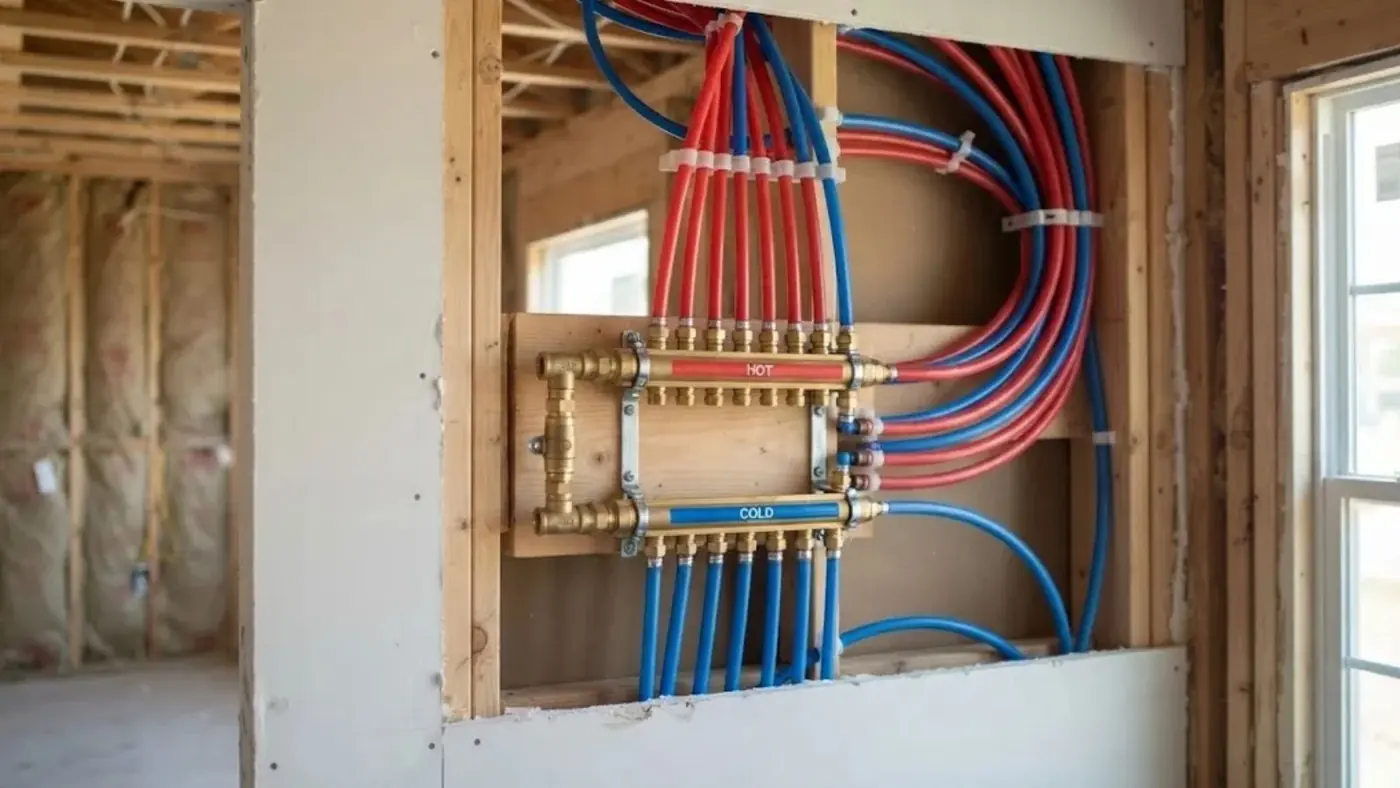
Whole House Repiping in Canton, MA
- Same-day appointments when available
- Copper or PEX options
- Clear price before work starts
- Licensed and insured
Whole-house repiping means replacing the supply lines that carry water to every tap, from the meter or main shutoff to the last fixture. If your Canton, MA home has brown water at the first flush, a shower that has faded to a trickle, or a third pinhole leak in a year, the pipes themselves are probably the problem, not the fixtures.
This is planned work, not an emergency call, so you have time to compare materials and understand the steps. A plumber starts by testing pressure and looking at the pipe before anyone opens a wall, and you should hear a clear price before work starts.
Symptoms that point to worn-out supply pipes
One odd faucet is usually a faucet. These patterns across the whole house are what push a plumber to recommend replacing pipe instead of patching it.
Rust-colored water
Brown or orange water that clears after a minute, mostly from hot taps, often means the pipe wall is corroding from the inside.
Pressure that fades
Strong at the street side of the house, weak at the far bathroom. Mineral buildup narrows old steel pipe until little flows through.
Pinhole leaks
Tiny sprays or green crusting on copper. One is a repair. Three in different rooms tell you the whole run is thinning.
Metallic taste or stains
Rust or blue-green stains around drains and a coin-like taste suggest the pipe is shedding metal.
Hammering and rattling
Loose, brittle or collapsed pipe can bang when a valve closes, especially where old runs were clamped years ago.
Galvanized, polybutylene and copper: what each one does when it fails
The age of the house tells you which pipe to suspect, but only a look at the pipe confirms it. Here is what a plumber checks for on each type.
| Pipe type | How to spot it | How it usually fails |
|---|---|---|
| Galvanized steel | Dull gray, magnet sticks, threaded joints at fittings | Rusts from inside, narrows, loses pressure, then leaks at threads |
| Polybutylene | Gray, blue or black flexible plastic with plastic or crimped metal fittings | Fittings and pipe walls degrade and split, often without warning |
| Copper, thin or older | Reddish brown or green, soldered joints | Pinholes from the inside, leaks at old solder joints, pitting |
| Mixed old and new | Brass or copper patches spliced into steel | Leaks at the splice where two metals meet, plus uneven pressure |
Galvanized pipe replacement
Galvanized steel was coated in zinc to resist rust, and for a long time it worked. Eventually the zinc wears away and the steel rusts, and the scale builds up inside until a three-quarter inch pipe flows like a half-inch one. You can confirm it by scratching the pipe near the meter with a screwdriver and seeing gray metal, then holding a magnet to it.
Galvanized lines are rarely worth patching. Cutting in a new section of copper beside rusted steel makes a weak joint, and the next leak shows up a foot away. If the steel is only in a short stretch such as the basement run, a partial repipe may be enough, and a plumber can tell you after checking pressure at several fixtures.
Do you need a repipe or just repairs?
Ask what the failure looks like. A single leak at a fitting in otherwise sound pipe is a repair. Leaks that keep returning in new spots, pressure that is poor at every fixture, or discolored water throughout all point to the pipe wall itself.
A plumber can run a pressure test on the supply side with the fixtures shut off, watching whether the gauge holds. If you have already had a leak detection visit and the findings are several small leaks across different runs, that evidence supports replacing the system rather than paying for repair after repair.
Be careful with anyone who says the whole house must be done without looking. Sometimes a house with one bad branch needs only that branch redone.
Copper or PEX: honest trade-offs
Both are accepted supply materials. Neither is better in every house, and the choice often comes down to walls, budget and preference.
Copper tends to fit when
- You want a metal pipe that tolerates heat near the water heater
- Exposed runs in a basement should look neat
- The existing system is copper and you prefer to match it
- You are comfortable with soldered joints that take more labor
PEX tends to fit when
- Walls are finished and long continuous runs avoid opening them
- Pipe will be pulled through tight cavities or around corners
- Labor time and drywall repair need to stay low
- You can accept plastic pipe and the fittings that go with it
Wall access: how much drywall comes out
Flexible PEX can be fished through a stud bay from a basement or attic with a few small access holes, often one per fixture group. Rigid copper needs longer straight paths and more openings, especially where a run turns a corner inside a wall.
Ask where the access holes will go before work starts. Behind a vanity, inside a closet or at a tub's access panel, a hole is easy to patch. In the middle of a tiled wall it is not. A good plan marks the holes on the wall so you can approve them, and the patching responsibility is settled before cutting begins.
Is the water in your house telling you the pipes are done?
Describe the color, pressure and leak history and a plumber can say whether repair or repipe makes sense.
How a repipe is staged so you keep water
Most homes do not lose water for days. The work is sequenced in zones, and the main shutoff is the only thing that stays closed for most of the day.
Shut off and drain
The main is closed, the lines are drained, and the water heater supply is isolated so nothing is flowing through old pipe.
Rough in the new trunk
New mains and branches are run through the basement or crawlspace first, with shutoff valves added at each group.
Work through the rooms
Branches go to kitchen, bathrooms and laundry in turn. The old pipe is cut out as each room is finished.
Pressure test
The new system is filled and held under pressure to prove it, and the inspector sees it before walls are closed if one is required.
Restore and flush
Water is turned back on, faucet aerators are cleaned, and each fixture is run until the water is clear.
What Canton's water and housing mean for your pipes
Canton buys part of its water from the MWRA and pumps the rest from town wells, and the town adjusts pH to reduce lead and copper picked up from plumbing. That treatment helps, but it does not repair a corroding pipe inside your wall, so rust-colored water at the tap is still a pipe condition worth looking at.
Much of the town's housing was built in the mid to late 20th century, when large suburbs were laid out, and about 69 percent of units are single-family houses. That tells you many owners have a whole supply system to consider, but not which material is in your wall. Look at the pipe near your meter, and ask the Canton Water/Sewer Division who is responsible for the line before and after the meter.
Permits and inspection under 248 CMR 3.05
Repiping is plumbing work that needs a permit. Under 248 CMR 3.05, work may not start until the inspector issues a permit, and permits go only to properly licensed individuals, not apprentices.
The inspector can require a rough-in inspection and a final inspection, and work generally cannot be covered until required tests are done. In Canton the Building Department takes plumbing permit applications online, accepts check payment only, and schedules no inspection until the permit is paid. A permit is invalid if work does not start within 90 days. Ask the Canton Building Department about your specific job, and you can verify any plumber's license with the state board.
What changes the cost of repiping a house
Two houses of the same size can have very different totals. These are the factors that move the number.
Number of fixtures and floors
More bathrooms, a second-floor laundry and a long basement run each add pipe, fittings and hours.
Material choice
Copper costs more in material and labor than PEX, and fitting type matters more than the pipe itself.
Wall and ceiling access
Open basement ceilings are quick. Finished plaster, tile or a slab-on-grade layout take longer and add patching.
Full or partial scope
Replacing one branch is far smaller than redoing every riser and drop.
Permits and testing
Inspection and test time are part of the job, and the town's permit process sets part of the schedule.
Homeowners insurance usually does not pay to replace pipes that are simply old. It may cover sudden water damage from a break, but gradual leaks and corrosion are commonly excluded, so read the policy wording or ask your agent.
Repiping questions in Canton, MA
How long does a whole-house repipe take in a typical Canton house?
Most single-family homes take a few working days, depending on the number of bathrooms, wall access and inspection timing. Water is usually off for part of each day rather than for the whole job, and the plumber should explain which fixtures will be out when. Call (617) 752-0573 and describe your house for a better picture of the schedule.
Do I have to pick between copper and PEX before you quote?
No. A good quote explains both and shows how the wall access and the pipe layout change with each. Choose the one you are comfortable owning, and ask what fittings are used, because the connection type is usually the weak point in any system.
Can pipe replacement be done a room at a time?
Yes, when the failing part is limited, such as a basement trunk line or one bathroom branch. The catch is that new pipe joined to old can still leak at the splice, so a plumber looks at what remains and tells you honestly if you are only delaying a bigger job.
Is galvanized pipe still safe to drink from?
Rusty galvanized pipe mostly affects taste, color and pressure, but it can also release metal into the water. If you are worried about lead or other metals in your water, test it with a certified lab and ask the Canton Water/Sewer Division what they know about your service line.
Will I need to leave the house during a repipe?
Usually not, but expect noise, dust and a few hours without water on the day the main is closed. People with small children or medical equipment that needs water often arrange to stay elsewhere for a day, and the plumber can help plan around that.
Can I skip the permit if my plumber handles it?
The permit is still required, and only the licensed plumber can pull it. Work cannot generally be covered until the required tests are done. Ask the Canton Building Department about your specific job if you are unsure what applies.
Related services and nearby towns
If pressure drops only at certain times of day, the trouble may be in the line from the street, which is covered in our water line repair page. A pipe that has already let go and is flooding a room is a burst pipe repair call, not a planned repipe.
Neighbors in Norwood who are planning a pipe replacement can read about plumbing help in Norwood, and bathroom remodels that change the layout also involve plumbing installation and its own inspections.
Sources and standards
These are the primary sources this page relies on. Anything not listed here is general plumbing practice, and local rules should be confirmed with the town.
- 248 CMR 3.05, the Massachusetts plumbing and gas fitting regulation, as published by Cornell LII
- Town of Canton Building Department, online permitting page (plumbing and gas permits)
- Plumbers and Gas Fitters consumer fact sheet, Massachusetts Board of State Examiners of Plumbers and Gas Fitters
- Canton Water/Sewer Division 2023 water quality letter, distributed through the MWRA community page
- Canton Housing Production Plan 2025, published on Mass.gov
Ready to replace the pipes?
Call to schedule a visit. Same-day appointments are offered when available.
Call (617) 752-0573