Tankless Water Heater Service in Canton, MA
- Flush and descale service
- Error code diagnosis
- Clear price before work starts
- Licensed and insured
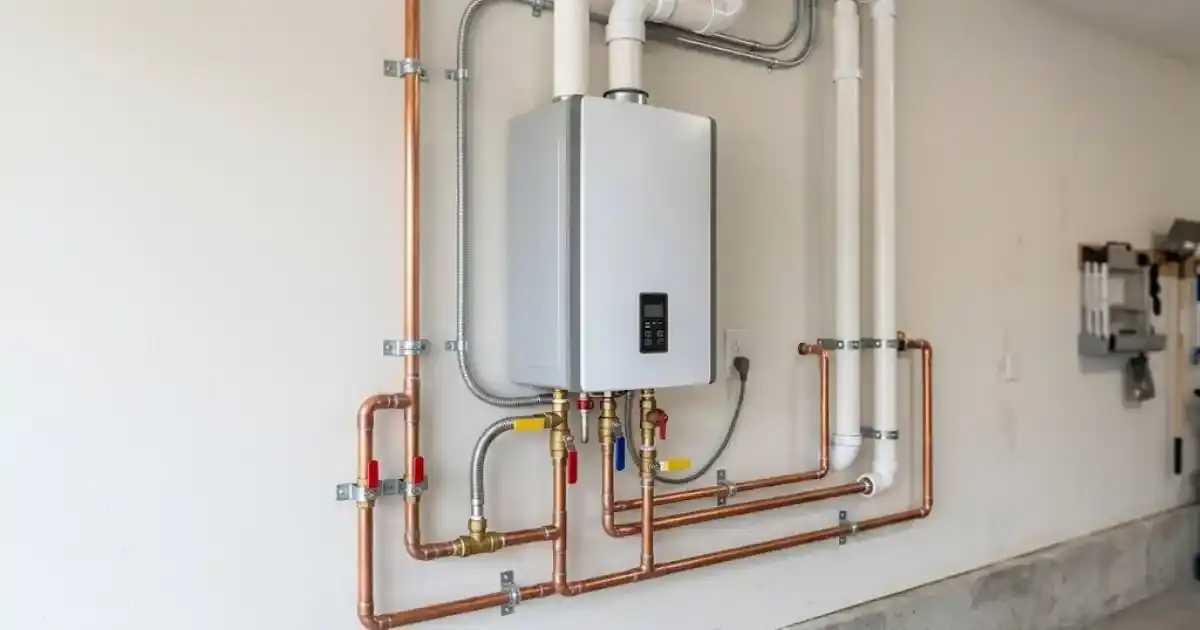
A tankless water heater in Canton, MA heats water only when a tap opens, so it fails differently from a tank. You get lukewarm water, cold bursts between uses, a shutdown mid-shower or an error code on the display, and scale inside the heat exchanger is one of the most common causes.
Our tankless water heater service covers flushing and descaling, error code diagnosis, repairs, and installing a new unit sized for your fixtures. This page is for planned work and nuisance faults. A unit leaking water or smelling of gas is a different matter, and the last symptom card below gives the safety steps.
Tankless symptoms and what they usually point to
The pattern you notice is more useful to a plumber than the brand name. Match your symptom, then tell the dispatcher what you see.
Lukewarm and never fully hot
Scale on the heat exchanger, a partly blocked inlet filter, or a flow sensor that reads wrong. A flush is often the first fix.
Hot, cold, then hot again
The cold water sandwich. A short pause between draws lets the water in the pipe cool, and it is normal unless it has gotten worse.
Shuts off at a low flow
Most tankless units need a minimum flow to fire. A clogged aerator or inlet screen can drop the flow below it.
Error code on the display
The unit has detected ignition, vent, flow, temperature or condensate trouble. Write the code and the number of flashes down.
Rumbling, popping or kettle noise
Mineral scale is boiling water on the exchanger surface. Do not ignore it, because scale eventually cracks a heat exchanger.
Water leaking or a gas smell
Close the water and gas valves. If you smell gas, leave the house and call the gas utility or 911, then call a plumber.
Tankless water heater flush and descaling: what it is and when it is due
Scale forms where water is hottest, which in a tankless unit is the narrow passages of the heat exchanger. Even a thin layer cuts heat transfer, raises the burner or element load and shortens the life of the unit. A flush dissolves that layer with a descaling solution, usually white vinegar or a manufacturer-approved cleaner, circulated by a small pump for roughly an hour.
The flush needs two service valves on the water connections, so hoses can attach to the unit. If your installer never fitted them, a plumber can add them first, and that makes every later flush quicker. During the visit the plumber also cleans the inlet screen, checks the gas and vent, and for condensing models checks the condensate neutralizer.
How often depends on the hardness of your water and on how much hot water you use. Follow your manufacturer's interval, and do it sooner if you see lukewarm water, noise or a drop in flow. Unflushed tankless units commonly fail earlier, and scale damage is the sort of problem some warranties exclude, so read yours.
Reading tankless error codes
Code numbers differ from brand to brand, so check your manual for the exact meaning. These are the groups most units share.
| Code theme | What it usually means | What a plumber checks |
|---|---|---|
| Ignition failure | The burner did not light or the flame sensor lost the flame | Gas supply and pressure, igniter, flame sensor, and condensate backing up |
| Vent or exhaust fault | The unit sees blocked or restricted exhaust or intake air | Vent run, terminations outside, bird screens, snow or ice, and loose joints |
| No flow or low flow | Water is not moving fast enough for the unit to fire | Inlet filter, shutoff valves, faucet aerators, and the flow sensor |
| Overheat or high limit | Outlet water or the exchanger got too hot | Scale, temperature sensor, flow regulation, and recirculation setup |
| Condensate fault | The condensate drain or neutralizer is blocked | Drain line, trap and neutralizer cartridge, and freezing in cold spaces |
| Scale or heat exchanger warning | The unit senses poor heat transfer | Flush and descale, then test again before replacing parts |
Gas or electric tankless: what each demands from your house
The gas and electric versions behave differently in the home, and the right one depends on what your house can supply.
Gas tankless needs
- A gas line sized for its higher input
- A sealed vent path through a wall or roof
- A condensate drain for condensing models
- Electric power for the controls, so it stops in an outage
Electric tankless needs
- Large dedicated circuits, often more than one
- Spare panel capacity, and sometimes a service upgrade
- No vent and no gas, so placement is flexible
- A smaller flow rate in cold weather without more power
Is your tankless giving lukewarm water?
Tell a plumber what you see on the display and when the water runs cold, and they can tell you if it needs a flush or a repair.
Tankless installation and repair
Size a tankless unit by the flow in gallons per minute you need at your busiest moment and by the temperature rise. New England winters mean incoming water is much colder than in summer, so the same heater delivers less flow in January. Size for winter, not July, or the second shower will run cooler than the first.
Repair parts are the ones that live in the combustion and flow path: the igniter, flame sensor, flow sensor, temperature sensor, fan and, in the worst case, the heat exchanger. A plumber tests before replacing anything, because many faults that look like part failures clear after a flush. Where an exchanger is cracked, a new unit is usually the better path, and water heater installation covers the permit and the vent decisions.
If your tankless was installed on a gas line or a vent that is too small, no repair fixes it. A plumber can tell you after checking the gas pressure at full fire, and sometimes the answer is a larger line or a different location.
Water quality, neighbors' reports and what to test at your tap
Canton's own water report does not give a hardness figure. Ask the Canton Water/Sewer Division for the current number or test your tap with a kit, because that number sets how fast scale forms in a tankless exchanger. A neighbor's town is no guide. The Dedham-Westwood Water District tested hardness in 2025 and called it moderately hard. Randolph's 2024 report listed a single soft sample.
Water chemistry differs between neighbors like Westwood and Randolph, so a flush schedule borrowed from a neighbor may be too loose or too tight for you.
Canton draws on two sources, the MWRA and town wells, and the mix shifted between 2022 and 2023. Your own tap is what counts. Winters here also bring hard freezes, so a tankless unit in an unheated garage needs its vent, condensate line and water connections protected from freezing.
What affects tankless service and installation costs
A flush and a new install sit at opposite ends of the range. These are the factors a plumber weighs before giving you a price.
Service valves
Without them, a flush starts with adding the valves. With them, it is a short, routine visit.
Scale level
A unit flushed regularly cleans up fast, while one with heavy scale may need a longer soak or repeated cycles.
Fuel and capacity
A larger gas line or a heavier electric service is often the biggest part of a new tankless install.
Venting and condensate
Longer vent runs, wall penetrations and a condensate drain add labor and materials.
Parts versus replacement
A failed sensor is a modest repair. A cracked heat exchanger often costs enough that replacing the unit makes more sense.
Tankless wear and scale damage are maintenance matters and are usually not covered by homeowners insurance. A sudden leak that damages a room is often covered, but gradual leaks are commonly excluded.
Tankless water heater questions in Canton, MA
How often should a tankless water heater be flushed?
Follow the maker's interval, which is commonly once a year, and flush sooner if the water runs lukewarm, the unit rumbles, or flow drops. How often depends on hardness and use. Because Canton's report gives no hardness figure, ask the Canton Water/Sewer Division or test your tap.
Why does my tankless heater give lukewarm water or cold bursts?
Lukewarm water usually means scale, a dirty inlet screen or a bad sensor. Cold bursts between uses are the cold water sandwich, which is normal to a degree. Lukewarm plus a code or noise is the sign to book a flush and an inspection.
What do the flashing lights or error codes on a tankless heater mean?
Each brand uses its own codes, but most fall into ignition, vent, flow, overheat or condensate problems. Write down the code and read your manual. A plumber can then check the gas, vent, filter and sensors in order and clear the fault.
Will my tankless heater work in a power outage?
Not without backup power. Even gas units need electricity for the fan, the igniter and the controls. A small battery backup or generator connection can keep one running, but check what it must supply first.
Do I need a permit to install a tankless water heater?
Yes, plumbing and gas work needs a permit under 248 CMR 3.05, issued to a licensed individual. Ask the Canton Building Department about your specific job. A tankless gas install usually involves both a plumbing and a gas permit.
Is a tankless heater worth it compared with a tank?
It can be, if your house can supply the gas or electric load it needs and you maintain it. The trade-off is a higher install price and annual flushing. If you only need a straight swap, water heater replacement covers tank options.
Related services and nearby towns
If your home still has a standard tank that is leaking or running cold, water heater repair covers those faults. Tankless service also reaches the neighboring town of Norwood, which sits just west of Canton.
Sources and standards
These are the primary sources this page relies on. Anything not listed here is general plumbing practice, and local rules should be confirmed with the town.
- 248 CMR 3.05, the Massachusetts plumbing and gas fitting regulation, as published by Cornell LII
- Town of Canton Building Department, online permitting page (plumbing and gas permits)
- Plumbers and Gas Fitters consumer fact sheet, Massachusetts Board of State Examiners of Plumbers and Gas Fitters
- Canton Water/Sewer Division 2023 water quality letter, distributed through the MWRA community page
Tankless acting up?
Call and tell us the code or symptom. A plumber can say if it needs a flush or a repair.
Call (617) 752-0573