
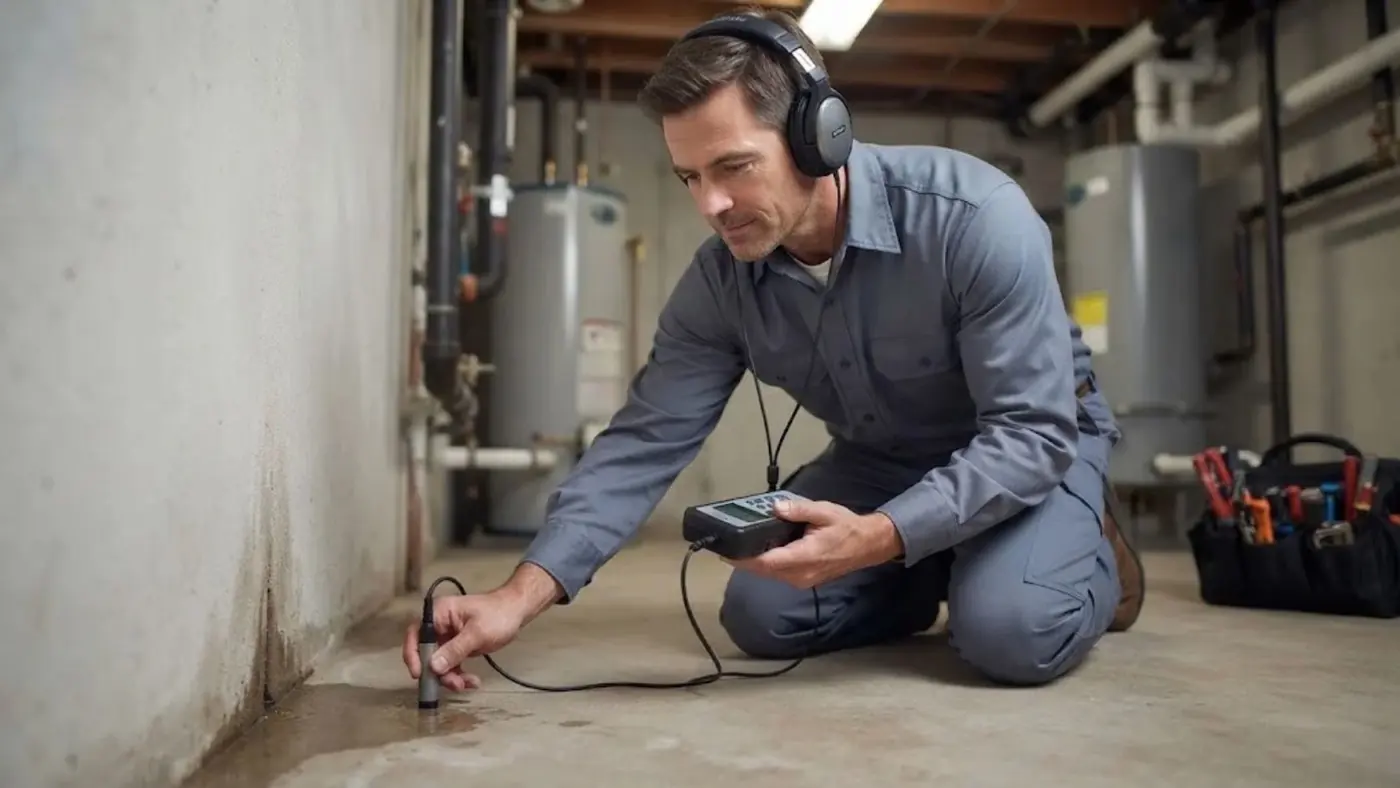
Emergency Leak Detection in Canton, MA
- 24/7 dispatch
- Acoustic, thermal and pressure testing
- Clear price before work starts
- Licensed and insured
Hidden water is the expensive kind, and if it is soaking a ceiling or running under a floor in your Canton, MA home tonight, our 24/7 dispatch can send a licensed plumber. While you wait, shut the main valve if you can find it, and keep everyone out from under any bulging ceiling.
Emergency leak detection means locating a leak you cannot see without opening more of the house than necessary. A plumber combines a meter test, listening gear, a thermal camera and pressure testing to narrow the leak to a few feet, then tells you what the repair involves.
Water bill up, stain spreading, floor warm: what the symptom points to
You rarely see a leak. You see what it does to the house, and each effect narrows where the pipe is failing.
Bill jumped, no new habits
A steady loss somewhere between the street and the fixtures, often a toilet flapper, a buried line or a pipe inside a wall.
Brown ring on a ceiling
Water is dripping from a supply or drain above. The stain sits below the wet spot, not at the source.
Warm patch on the floor
A hot water line in or under a slab, or a heating loop, is leaking and heating the concrete.
Pressure dropped on every tap
A large leak ahead of the house, such as a failed service line, takes pressure away from all fixtures at once.
Water pouring through a ceiling or a floor right now: first steps
If water is actively escaping, you do not need a diagnosis yet. You need it stopped, and the person who locates the leak can do that after the water is off.
Close the main valve
It is usually where the pipe enters the house, often in the basement near the meter. Turn the handle until it stops, or a quarter turn if it is a lever.
Deal with a sagging ceiling
A ceiling holding water can drop without warning. Stay clear, and if you can do it safely, poke a small hole in the lowest point and let it drain into a bucket.
Stay off wet circuits
If water is near outlets, light fixtures or a panel, do not touch them. Shut the breaker only from dry footing, or call for help.
Call 24/7 dispatch
Say where the water is, whether the main is off, and whether the stain is growing. That tells us which gear to load.
Is the meter running with everything off? A ten minute check
A high bill is the first sign most people notice, and the meter settles whether the loss is on your side of it. Do this before anyone opens a wall.
Stop all water use
Close taps, pause the dishwasher and washer, and shut off any ice maker or humidifier. Make sure nobody flushes.
Find the leak indicator
Most meters have a small triangle or dial that spins with even a trickle. Read the numbers and note the dial position.
Wait and look again
After ten to fifteen minutes with the house quiet, check the dial. Movement means water is leaving the system somewhere.
Close the main and recheck
If the dial still moves with your main valve closed, the leak sits between the meter and the main valve. If it stops, the leak is inside the house.
What the Canton Water/Sewer Division can tell you about a high bill
The town reported about 7,300 service connections in its 2023 water quality letter, and your account is one of them. Call the Canton Water/Sewer Division and ask what readings its records show for your address, and whether use climbed gradually or jumped on a certain date.
That history is useful because it separates a sudden break from a slow leak. A bill that doubled in one cycle suggests a new failure, and a gradual rise suggests a toilet or a pinhole.
How a plumber finds a leak without tearing up the house
Detection starts with isolation. The plumber closes branches one at a time and watches the meter or a flow meter to learn which part of the system is losing water. A pressure test then confirms it: the line is capped, pressurized with water or air, and a gauge that falls gives you proof of a leak and a number to compare after the repair.
Acoustic listening comes next. Ground microphones and contact sensors pick up the high-pitched hiss of pressurized water escaping from a pipe, and the sound is loudest directly over the break. Metal pipe carries the noise farther than plastic, so the plumber listens at several points and triangulates.
Thermal imaging shows temperature differences through drywall and flooring, so a warm band on a cold wall suggests a hot water line and a cool patch suggests a cold line or a wet spot. A moisture meter then checks the reading by touch. For stubborn cases, tracer gas (a safe hydrogen and nitrogen mix) is pushed into an empty line and a sniffer finds where it escapes.
Ceiling and wall leaks: tracing the water back to its source
Water travels along joists, studs and pipes before it shows itself, so the stain is often a few feet from the real leak. A plumber starts at the highest wet point and works up, checking supply lines, drain lines, a shower pan, a toilet seal or a roof penetration above.
A moisture meter and thermal camera mark the wet area, and the plumber opens the smallest access hole that reaches the pipe. If the plumbing pressure test comes back clean, the water may be rain from the roof, and a roofer is the next call.
Leaks under the house, in a crawlspace or below a basement stair
A plumber looks for drips, rust streaks, wet insulation and mineral crusts on copper joints, then listens along runs hidden behind a finished ceiling or soffit.
In a crawlspace, standing water does not always mean a pipe has failed. Groundwater, a drain line or a roof gutter discharging near the foundation can all fill it. Closing the main and watching whether the water level keeps rising separates a plumbing leak from a drainage problem, and a leak that stops when the main is closed is a supply line.
Water where it should not be, or a bill that makes no sense?
Dispatch can send a plumber with listening and thermal gear any hour of the day or night.
Slab leaks: warm floors, a hissing sound and a bill that will not make sense
A slab leak happens in a pressurized line running in or under a concrete floor. A warm spot underfoot, a hissing sound that continues with fixtures off, or a wet carpet edge with no obvious source are the common signs. Because the line is buried in concrete, these are urgent: the water can undermine the slab and soak flooring from below.
Detection combines acoustic listening on the floor with thermal imaging and line isolation to learn which pipe is leaking. You then have three options. Break into the slab and fix the pipe, reroute the line through walls or the attic, or replace the line. Rerouting avoids the slab. If the same line has leaked before, ask about repiping before you pay for several spot repairs.
Buried supply lines: leaks between the street and your foundation
A leak in the pipe that runs underground into the house shows up as a bill increase, low pressure, a soft or unusually green patch of lawn, or a sunken driveway edge. A meter that moves with the main closed puts the leak outside the house.
Locating a buried leak uses ground microphones and sometimes a tracer gas run through the line. Once it is pinpointed, a spot repair or a replacement section is a decision about the condition of the rest of the pipe. We cover that choice in more detail under water line repair, including when a line is worth replacing rather than patching.
Irrigation, pool and meter-box leaks outside the house
Sprinkler systems leak at valves, heads and buried fittings. A zone that stays soggy, a head that sprays unevenly or a bill that jumps in summer all point there. Close the irrigation supply and check the meter again. If it stops, the lawn system was the leak and a zone-by-zone test finds it.
Pools and spas lose water to evaporation too, so run a bucket test: set a bucket on a pool step with its level matched to the pool, wait a day, and compare. If the pool dropped more than the bucket, a line or fitting is leaking. Shell cracks are a pool company's job.
The meter box is the last outdoor suspect. Water pooling around the lid, a damp lawn near the curb or a meter that reads while the house is off may mean a leaking fitting at the meter. Call the Canton Water/Sewer Division first if you see water around the lid, since the meter and its fittings may be theirs to fix.
Which test finds which kind of leak
No single instrument works for every leak. This table shows what each method is good at and where it stops.
| Method | Best at finding | Where it falls short |
|---|---|---|
| Meter or flow test | Whether any leak exists on the supply side | Does not tell you where the water is going |
| Pressure test | A leak in an isolated section of supply pipe | Needs the line capped, and drains are tested differently |
| Acoustic listening | Pressurized leaks in a slab or buried line | Quiet leaks and plastic pipe give a weak signal |
| Thermal imaging | Hot water leaks, wet areas behind drywall | Shows temperature, so a plumber confirms the reading |
| Tracer gas | Small leaks in lines that resist other methods | Takes setup time and an empty, isolated line |
Canton's groundwater, winters and thaws: why a wet basement is not always a pipe leak
Canton's wetlands are concentrated along Route 138 in the east and I-95 in the west, and the Neponset River forms the town's boundary with Norwood, Westwood and Dedham. In those areas groundwater can sit close to a foundation. If your basement is wet only after rain or a thaw, the water is probably coming from outside, so run the meter test before you pay for detection.
New England winters add a second cause. A pipe in an unheated wall or crawlspace can freeze, split quietly and show nothing until the thaw, when the leak starts. If the wet area is on an exterior wall and the weather recently turned, mention that to dispatch, because it changes where the plumber looks first.
What affects the price of leak detection
The price depends on how many tests the leak needs before it gives itself up. A leak you can hear through a basement ceiling costs far less to find than one under a finished floor.
Number of methods needed
One meter test may do. A hidden slab leak may need listening, thermal imaging and a pressure test.
Access to the pipe
Open basement ceilings are quick. Finished walls, tile and slabs add time and patching.
Opening and repair work
Finding the leak is one job and fixing it is another. A small access cut costs less than breaking a slab.
Time of the call
Night and weekend dispatch carries after-hours scheduling, and you hear the price before work starts.
Policies commonly cover sudden damage from a pipe that bursts and often exclude a slow leak that went on for weeks. Some cover the cost of tearing out to reach a leak, and many do not cover finding it, so read your policy wording or ask your agent.
Leak detection questions in Canton, MA
Do you handle leak detection emergencies at night or on weekends in Canton, MA?
Yes. Our dispatch line is staffed around the clock, every day. A ceiling dripping at midnight, a floor you can feel warming or a meter spinning with everything off is treated as urgent, and a plumber is scheduled the same day when available. The price is given to you before work starts, so you can say yes or no with the facts.
How do I know if my water meter is showing a leak?
Turn everything off, then watch the leak indicator or the small dial on the meter for ten to fifteen minutes. Any movement means water is leaving your pipes. Close the main valve and check again: if it stops, the leak is inside the house, and if it keeps moving, the leak is on the supply side between the meter and your main valve.
How can I tell groundwater from a plumbing leak in my basement?
Shut the main and watch. If water keeps appearing with the main closed, or only after rain and snowmelt, the source is outside the plumbing. If it stops when the main is off, a supply pipe is the cause. Wet floors that show up in spring are usually drainage, which is where basement waterproofing comes in.
Will homeowners insurance pay for the leak and for finding it?
It depends on the wording. Sudden damage from a burst or failed pipe is often covered, while damage from a leak that went on slowly is commonly excluded. Many policies pay for the damage but not for locating the leak itself. Ask your agent before you open a claim, and keep photos of the damage and the meter reading.
Is the leak my responsibility or the town's?
The public main is the town's, and the plumbing inside your house is yours. The stretch in between, including the meter and the valve beside it, depends on your property, so ask the Canton Water/Sewer Division which fittings are theirs before anyone digs.
Related services and nearby towns
A leak that has already split a pipe moves into burst pipe repair, and a line that keeps failing in different places is often a case for whole-house repiping. Homeowners in nearby Norwood can call the same dispatch through our Norwood plumbing page for leaks that start the same way.
Sources and standards
These are the primary sources this page relies on. Anything not listed here is general plumbing practice, and local rules should be confirmed with the town.
- Plumbers and Gas Fitters consumer fact sheet, Massachusetts Board of State Examiners of Plumbers and Gas Fitters
- Canton Water/Sewer Division 2023 water quality letter, distributed through the MWRA community page
- Geography reference for Canton, MA (Wikipedia and MWRA)
Is water running where you cannot see it?
Call the 24/7 line. Close the main first if you can, and a plumber will be sent to locate the leak.
Call (617) 752-0573