
Basement Waterproofing in Canton, MA
- Interior drains and sump systems
- Crack and floor joint repair
- Clear price before work starts
- Licensed and insured
A basement that gets wet after rain, shows white mineral stains on the block or smells musty has a water entry problem, and basement waterproofing in Canton, MA is the work of giving that water a controlled place to go. This page covers the plumbing side: interior drains, sump pumps and sealing the cracks.
Waterproofing is not one product. It is a diagnosis first, then a mix of drainage, sealing and grading, matched to how the water gets in. Some of it a homeowner can do, and some of it should not be skipped.
Where basement water comes from, and why the source decides the fix
Water enters a basement in four common ways. Groundwater pushes up through the floor and through the joint where the floor meets the wall. Rain soaks the soil and presses water through cracks in the wall. Surface water pools beside the house because of grading or gutters. And a plumbing leak inside the house can look exactly like all of the above.
That last one is why you start by ruling out pipes. Shut the main and check the water meter for movement, and look at the water heater, washer hoses and any supply lines on that level. If the wet spot appears only after rain or a thaw, it is groundwater. If it shows up on dry days, call for leak detection before spending anything on drains.
What the signs on your walls and floor usually mean
| What you see | What it usually means | Typical approach |
|---|---|---|
| White powder on block or concrete | Water moving through the masonry and leaving salts (efflorescence) | Find the source, then drainage or sealing |
| Vertical hairline crack, damp after rain | Shrinkage crack that lets water through | Inject the crack, fix outside drainage |
| Horizontal crack in a block wall | Soil pressure bending the wall | Needs a structural assessment, not a sealer |
| Water along the floor-wall joint | Groundwater rising at the weakest seam | Interior perimeter drain to a sump |
| Wet only in one corner | Downspout or grading sends water to that spot | Extend downspouts, regrade first |
Canton's wetlands and rivers, and what they mean for your basement
Wetlands in Canton are concentrated in the east along Route 138 and in the west along I-95, and the Canton River passes through a chain of ponds to the Neponset River. If your house sits near these, the water table can sit close to the foundation. That makes drainage and a pump more sensible than a coating alone, which only holds back so much water pressure.
Canton also sees a New England freeze and thaw cycle. Heavy spring rain on saturated or thawing ground loads a basement all at once. A basement that is dry in July may still fail in March, so judge it in the wet season.
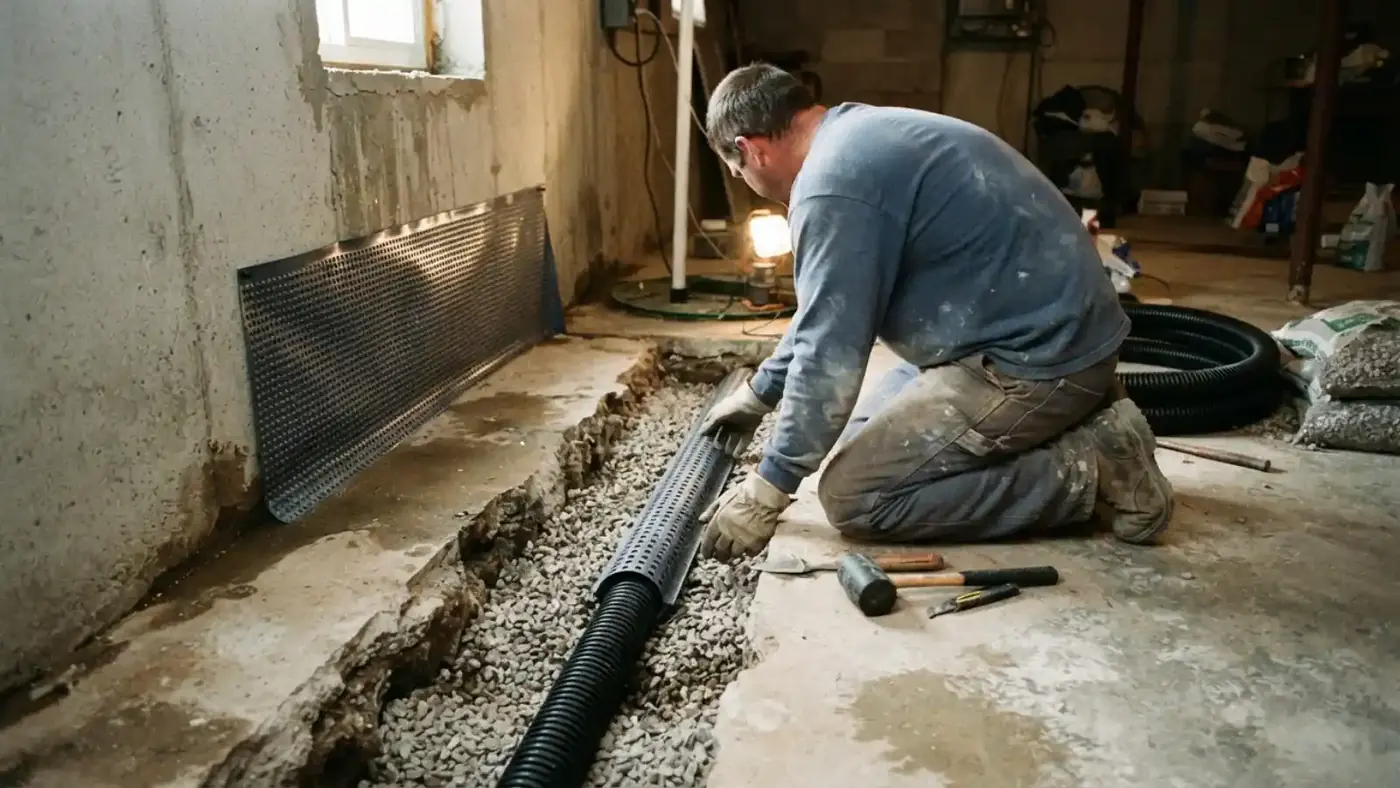
Interior drainage: how a perimeter drain and sump system is installed
An interior drain takes water that is already under the slab or at the wall and sends it to a pump, so it never reaches the finished floor.
Cut the floor edge
A strip of concrete along the wall, usually a foot or so wide, is saw-cut and removed to expose the footing.
Lay the drain
Perforated drain pipe or a channel goes along the footing, sloped toward a low point, and is bedded in washed stone.
Set the sump pit
A pit with a pump and a float is placed at the low point, with a discharge line out and away from the foundation. See sump pump repair for the pump side.
Patch the concrete
New concrete is poured over the drain and finished to match, with a wall-side channel kept clear for water to enter.
Interior drain or outside work: which fits your house
Exterior work addresses the source but involves excavation and is often a separate contractor's job.
Interior drain and sump fit when
- Water appears at the floor-wall joint
- The wall is sound and the problem is hydrostatic pressure
- Outside access is blocked by a deck, walk or neighbor
- You want the work done without excavation
Outside work fits when
- Water pours through a wall crack above the floor
- Grading slopes toward the house
- Gutters and downspouts empty at the foundation
- Exterior membrane or drain is failed
Is your basement damp every spring?
Call dispatch and a plumber can check the sump, the floor edge and the pipes before you decide on a plan.
Wall and floor cracks: injection, patching and when it is structural
Hairline vertical cracks from concrete shrinkage are the common case. A plumber or waterproofer injects them from inside, using epoxy when the goal is to bond the concrete and polyurethane when the goal is to seal a crack that moves or weeps. Both fix the crack, not the water pushing at it.
A horizontal crack, a wall that bows inward or steps in a stair-step pattern through the block is different. That points to soil pressure on the wall. A sealer will not hold it back. Have a structural engineer look at it before any waterproofing money is spent.
Waterproof drywall in a basement: what it does and what it does not
Waterproof drywall, often made with a fiberglass or paperless face, resists mold better than standard paper-faced board. It does not make a wall waterproof. If water gets behind it, the board survives better but the framing, insulation and the concrete wall still sit wet.
The order that works is to stop the water first with drainage and crack repair, let the wall prove dry through a wet season, and then finish it. Use moisture-tolerant materials such as foam board against the concrete, and leave a small gap at the floor. Ask the Canton Building Department what permits and inspections finishing a basement requires.
What basement waterproofing cannot do
No system keeps every drop out in every storm. Drains and pumps move water, and they depend on power, a clear discharge line and regular checks. A sump needs a backup in a storm. An interior drain does not stop humidity, and a coating will not hold back a wall under pressure.
It also does not repair a cracked sewer line or a failed supply pipe. If a camera inspection shows your floor drain or sewer lateral is the real source, see sewer camera inspection before you commit to drains, and be wary of any plan that promises a bone dry basement in every condition.
What affects the price of basement waterproofing
A single crack injection and a full perimeter system sit at opposite ends of the work. These are the factors that decide where yours falls.
Length of wall or floor edge
Interior drains are priced by the run, so a full perimeter costs more than one wall.
Floor and wall condition
Thick concrete, finished floors or stored belongings add demolition and moving time.
Pump and backup
A sump pit, pump and battery backup add equipment and electrical work.
Where the water goes out
A short, clear discharge is simple. A long run, or one that needs permission to reach a safe point, adds work.
Finishing work
Patching concrete, painting and new drywall are separate from the drain.
Standard homeowners policies generally do not pay for waterproofing, and groundwater seepage is commonly excluded. Some cover a sudden pipe burst. Ask your agent what is covered before you assume.
Basement waterproofing questions in Canton, MA
Is basement waterproofing a plumber's job?
Part of it. Plumbers install interior drains, sump pits and pumps, discharge lines and backups, and rule out leaking pipes. Exterior excavation, structural wall repair and major grading are often handled by other trades. We tell you which parts we do and which need another contractor.
Will waterproof drywall keep my basement dry?
No. It resists moisture and mold better than regular drywall, but it does not stop water from entering. Fix drainage and cracks first, and finish the wall after it has stayed dry through a wet season.
What is the difference between waterproofing and dampproofing?
Dampproofing is a thin coating that slows moisture passing through concrete. Waterproofing manages liquid water under pressure, often with drains and a pump. A damp basement may only need the first, while a floor that floods after rain needs drainage.
Do I need a sump pump with an interior drain?
Usually, yes. The drain collects water, and the pump moves it out of the pit. Without a pump the water has no exit unless the drain can discharge by gravity to daylight, which basement slopes rarely allow.
How do I know if the water is from a plumbing leak or groundwater?
Close the main, check the meter and watch the wet spot. Water that appears after rain and thaw is groundwater. Water that continues on a dry day or moves the meter points to a pipe, and that is a leak detection job.
Related services and nearby towns
A pump that fails in a storm is covered at sump pump repair, and a hidden pipe behind a wet wall is found through leak detection. For a house on the Westwood side of the Neponset, see our Westwood plumbing page for how service reaches that area.
Sources and standards
These are the primary sources this page relies on. Anything not listed here is general plumbing practice, and local rules should be confirmed with the town.
- Town of Canton Building Department, online permitting page (plumbing and gas permits)
- Geography reference for Canton, MA (Wikipedia and MWRA)
Tired of a wet basement every spring?
Call dispatch to book a visit and get a clear price before work starts.
Call (617) 752-0573