Emergency Water Heater Repair in Canton, MA
- 24/7 dispatch
- Gas, electric and hybrid units
- Clear price before work starts
- Licensed and insured
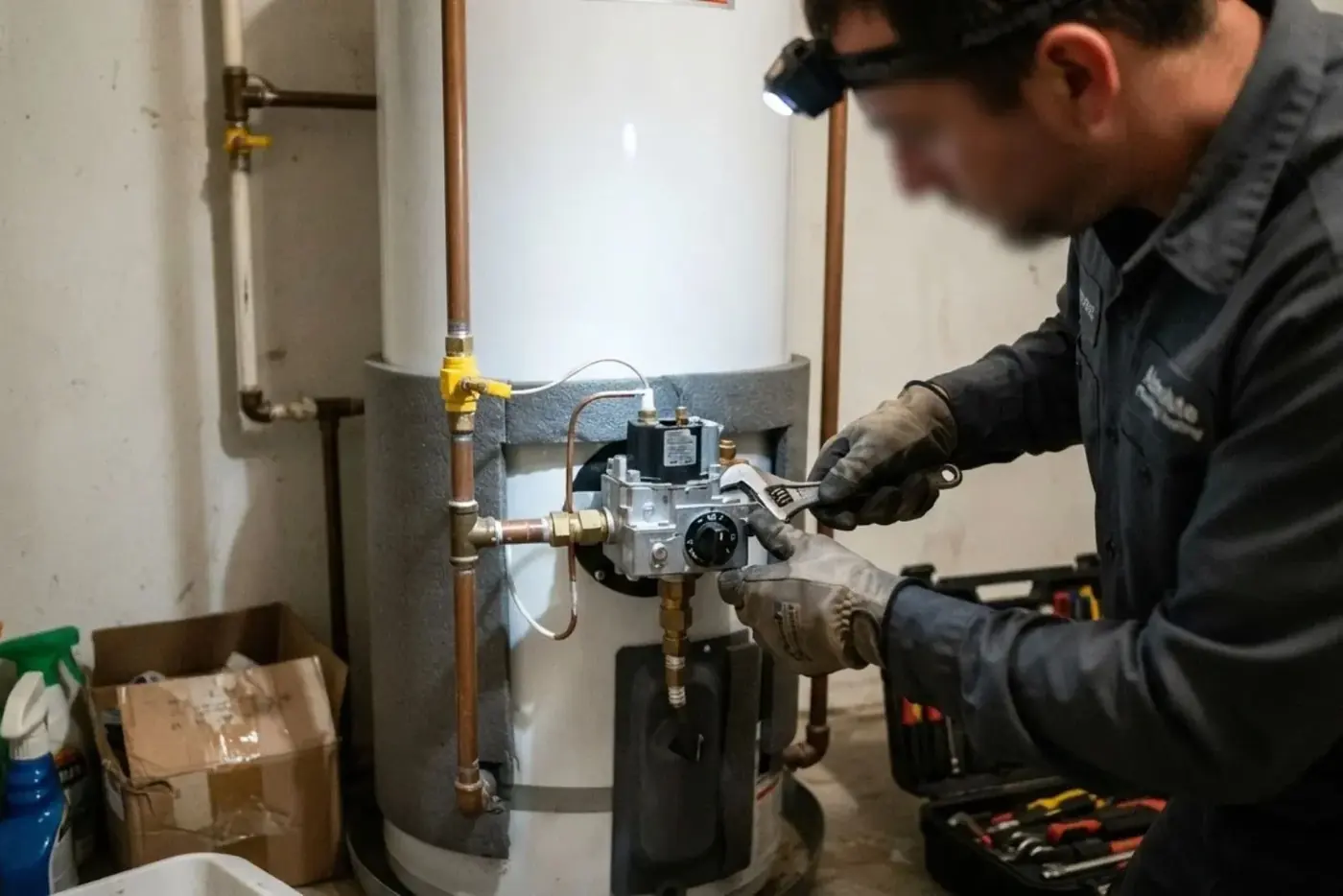
Water spreading from a water heater, or a shower that turns cold at night, is an emergency in Canton, MA, and our 24/7 dispatch sends a licensed plumber for it. While you wait, close the cold supply valve above the heater, switch off the breaker or the gas control, and stay out of the wet area.
Water heater repair means finding the one part that failed (an element, thermostat, igniter, thermocouple, valve or connection) and replacing it. It also means telling you plainly when the tank itself has corroded through, because no part swap fixes that.
Water around the heater: what to do before the plumber arrives
Water from a heater is often hot enough to scald, and an electric unit sits on a live circuit. Work through these in order, and call as soon as the valve is closed.
Close the cold supply
Find the shutoff on the pipe feeding the top of the tank. A lever parallel to the pipe is open, so turn it across the pipe. A round wheel handle closes clockwise. If it will not move, do not force it. Use the main shutoff instead.
Kill the power or fuel
For an electric heater, turn off its double breaker. A heater that runs without water burns out its elements. For a gas unit, turn the control dial to off or pilot.
Smell gas? Leave
A rotten-egg smell means everyone goes outside and you call the gas utility or 911 from there. Do not flip switches or look for the source. A plumber comes after the gas company clears the house.
Contain what you can
Lift boxes and stored items off the floor and run a wet vac if the outlet is dry. If water is near a panel or outlet, stay back and say so on the call.
Tell dispatch three things
Gas, electric or hybrid, roughly how old the tank is (the serial plate often encodes it), and whether the water is coming from the tank, the pipes or the side pipe.
Water heater leak: is it the tank, a fitting or just condensation?
Dry the heater and the floor with towels, then wrap a strip of dry paper towel around each connection and the drain valve. The first strip that darkens points to the source. This takes a few minutes and changes the whole conversation, because most leaks come from parts and not from the tank.
Fittings, flex connectors, the drain valve and the relief valve can be replaced on a sound tank. A tank leak looks different: rust streaks down the jacket, soaked insulation, or water that seems to come from underneath with every connection dry. Once the steel liner has corroded through, the repair options end, and the honest answer is a new heater.
Two leaks that are not leaks at all: a cold tank in humid weather sweats, and a gas heater makes condensation while it heats a cold fill. Neither makes a puddle that keeps growing. If water appears every day in the same spot, treat it as real.
What each kind of leak usually means
Use this as a first read. A plumber confirms with a dry check, a pressure gauge and a look at the tank bottom.
| What you see | What it usually means | What happens next |
|---|---|---|
| Drip from the pipes on top of the tank | Corroded or loose supply connection or a worn flex line | Replace the connector. Worth doing if the tank is sound. |
| Water running from the pipe beside the heater | Relief valve opening from heat, pressure or thermal expansion | Test the valve, check house pressure, and check for an expansion tank. |
| Drip at the drain valve near the floor | Worn valve seat, often after a flush | Replace the valve. A small, fast repair. |
| Rust streaks or water seeping from underneath | Tank wall corroded through | Replace the unit. No honest repair exists. |
| Wet base on a hybrid heat-pump unit | Clogged condensate drain or pan | Clear the drain line and check the filter. |
| Puddle but every connection is dry | Another pipe, a seep or groundwater | Trace the source before blaming the heater. |
Gas, electric and heat-pump hybrid heaters: what changes in repair
On a gas heater the failures are in the flame. The pilot goes out because the thermocouple or flame sensor is dirty or worn, the igniter on newer units stops sparking, or the gas control valve fails. Venting matters too: a blocked or loose flue lets exhaust spill into the room, and a plumber checks draft before leaving. Anything involving the gas line or a combustion problem is not a job to try yourself.
An electric heater has two heating elements and two thermostats, upper and lower. Elements burn out or scale over, a thermostat sticks, or the high-limit reset trips. Testing needs a meter and a live circuit, which is why the breaker comes off before any cover is opened.
A heat-pump hybrid adds a compressor, a fan, an air filter and a condensate drain on top of its backup elements. Its common faults are a clogged filter, a blocked condensate line and a unit in a closet too small to feed it air. It also cools its room, so a basement can feel colder after one is installed.
No hot water, or hot water that fades fast
Start with the fuel. A gas heater with a dark burner window usually has a pilot or ignition fault, and a tripped breaker or red reset button points an electric heater toward the thermostat or an element. If hot water lasts only a few minutes, a failed lower element or a broken dip tube is the usual cause. If the water is scalding, the thermostat is stuck on.
A heater that makes rumbling or popping sounds is boiling water trapped under a layer of sediment. Flushing can help a young tank, but a very old tank that has never been flushed may leak at the drain valve afterward. A plumber will tell you which case you have before opening the valve.
Is your water heater leaking right now?
Close the cold valve, cut power or fuel, and dispatch will send a plumber who carries common parts.
Parts a plumber replaces, and what failure looks like
Anode rod
A sacrificial rod that corrodes so the tank does not. A rod worn to the core is a warning, and replacing it can add useful life to a tank that is not yet leaking.
Heating element
Electric units only. Symptoms are lukewarm water, a tripped breaker, or hot water that runs out in minutes.
Thermostat and high-limit
Cold water, scalding water, or a reset button that keeps tripping all point here.
Thermocouple, flame sensor, igniter
Gas units. The flame lights, then dies, or never lights at all.
Relief valve
Opens to protect the tank from heat or pressure. A valve that drips constantly is replaced, never capped.
Drain valve and connectors
Cheap parts that cause the most floor damage. They are replaced as soon as they weep.
Canton basements, cold winters and what your puddle really is
About 69 percent of Canton's homes are single-family houses, so the heater usually sits in your own basement or garage, and nobody else will notice a slow leak. Check the corner behind it once a month. A small damp ring caught early costs far less than a flooded finished basement.
Spring thaw and heavy rain load Canton basements, and the town has wetlands along Route 138 and I-95. Before blaming the heater, touch the water. Hot or warm water came from the heater or a hot line. Cold water that arrives after rain is groundwater, and the answer is a sump pump or drainage fix, not a heater repair.
The town's water report does not list a hardness figure. Ask the Canton Water/Sewer Division for the current number or test your own tap, because mineral scale is what coats elements and builds a sediment layer in the tank. Your result decides how often a flush and anode check are worth scheduling.
What decides the cost of a water heater repair
Repairs run from a quick valve swap to a gas control replacement. These are the factors that set where yours falls.
Which part failed
A drain valve or connector is simple. A gas control valve or a compressor in a hybrid is a bigger part and more labor.
Age and condition of the tank
Spending on a tank near the end of its life can mean paying twice. A plumber tells you if the tank bottom looks sound.
Access
A heater in a tight closet, under a staircase or in an attic takes longer to work around than one in an open basement.
Fuel type
Gas repairs add combustion and venting checks. Electric repairs add testing under power. Hybrids add the heat-pump system.
After-hours dispatch
A night or weekend call is priced for that time, and you hear the number before work starts. Same-day appointments are offered when available for less urgent faults.
Sudden tank failure that floods a room is often covered as water damage, while a leak that dripped for months is commonly excluded. The heater itself is usually a manufacturer warranty question, so keep the serial plate photographed.
Water heater repair questions in Canton, MA
Is it worth repairing a leaking water heater?
It depends on where the water comes from. A leak at a fitting, valve or connector is usually worth repairing on a heater with years left. A leak from the tank itself is not, because the steel has corroded through and no part replaces it. A plumber checks the source first, so you decide on facts. If the answer is a new tank, see water heater replacement.
Do you handle water heater repair emergencies at night or on weekends in Canton, MA?
Yes. Our 24/7 dispatch answers overnight and on weekends, and a heater leaking into a basement or a gas unit that will not stay lit is treated as urgent. You hear the price before work starts. Less urgent faults, like lukewarm water, may get a same-day appointment when available.
Why is my water heater not heating?
For electric, the usual causes are a tripped high-limit button, a failed thermostat or a burned-out element. For gas, a pilot that will not stay lit, a bad thermocouple or flame sensor, or a failed igniter. For a hybrid, a clogged filter or a locked-out compressor. Tell dispatch what you see and what fuel it uses.
Should I flush my water heater, and will that fix lukewarm water?
A flush removes loose sediment and can quiet a rumbling tank. It will not fix a dead element, a bad thermostat or a failed igniter. If the tank is very old and has never been flushed, ask first, because disturbing a crusted drain valve can start a leak.
The pipe beside my heater is dripping. Is that an emergency?
That is the relief valve discharge pipe. Occasional drips can come from thermal expansion. A steady stream, hot water or steam means the tank is over temperature or over pressure, so turn off power or fuel and call. Never plug the pipe. If the pipe is dripping into a leaking basement, burst pipe repair may also apply.
How do I find out how old my water heater is?
Read the serial number on the data plate. Many makers encode the month and year in the first letters and digits, though each brand has its own code. Photograph the plate and send it to dispatch, or ask a plumber to decode it on site.
Related services and nearby towns
If the source of a wet floor is not obvious, a leak detection visit can separate a heater leak from a hidden pipe leak. For Norwood, a short drive west, the same dispatch is described on the page about emergency plumbing in Norwood, and a full tank swap is covered on its own page.
Sources and standards
These are the primary sources this page relies on. Anything not listed here is general plumbing practice, and local rules should be confirmed with the town.
- Plumbers and Gas Fitters consumer fact sheet, Massachusetts Board of State Examiners of Plumbers and Gas Fitters
- Canton Water/Sewer Division 2023 water quality letter, distributed through the MWRA community page
- Canton Housing Production Plan 2025, published on Mass.gov
- Geography reference for Canton, MA (Wikipedia and MWRA)
No hot water or a wet floor tonight?
Call the 24/7 line and tell dispatch if the unit is gas, electric or hybrid.
Call (617) 752-0573