
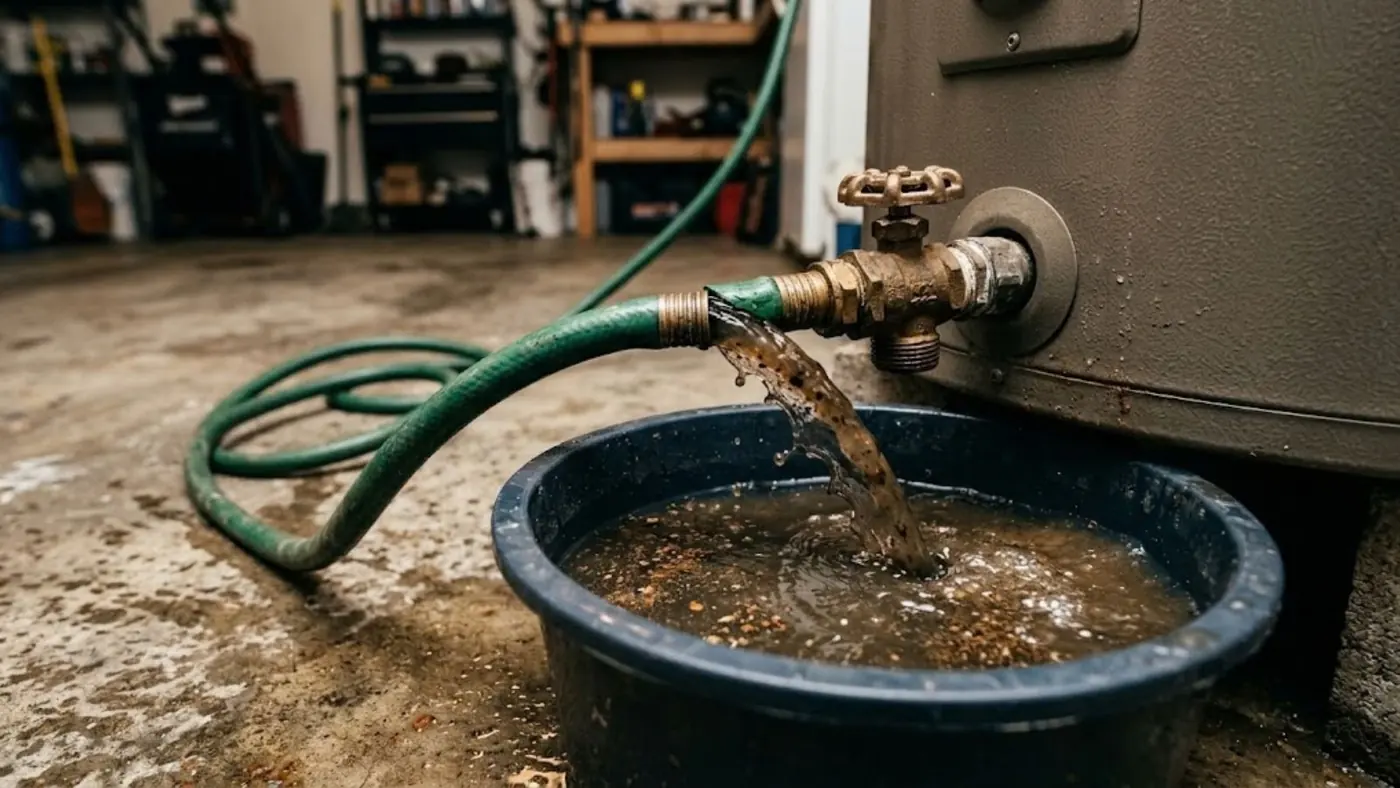
Water Heater Leak Repair Cost in Canton, MA
By Canton 24/7 Plumbing, 2026
The price of fixing a leaking water heater depends almost entirely on where the water is coming from. A loose fitting, a dripping relief valve or a failed drain valve is a modest repair. Water seeping from the tank itself means the steel has rusted through, and the cost question becomes what a new heater involves.
This guide for Canton, MA homeowners ranks the leak sources, explains what raises or lowers a bill, and gives you questions to ask before you approve work. It does not quote dollar figures, because any number given without seeing the unit would be a guess.
Water pooling around the water heater: what to do first
Before you think about price, make the area safe. These steps take a few minutes and cost nothing.
Cut the power or gas
For electric, switch off the breaker. For gas, turn the control to off or the gas valve to the closed position. If you smell gas, leave the building and call the gas utility or 911 from outside.
Close the cold inlet
Find the shutoff valve on the cold pipe entering the top of the tank and turn it clockwise. If it will not turn, close the main water shutoff instead.
Open a hot tap
Let the tank vent while you drain. Water inside is hot enough to scald, so never open the drain valve into a bare floor or toward your feet.
Protect and document
Move boxes off the floor, mop up, and photograph the wet area and the data plate. The model and age on that plate drive every repair decision.
Where the leak is, and what it means for the bill
A plumber sorts leaks into three groups. Check each location with a dry paper towel and a flashlight.
| Leak location | What usually fails | Bill direction |
|---|---|---|
| Top, at pipe connections | Loose fitting, worn flex connector, failed dielectric nipple | Low. Parts are small and cheap, labor is short |
| Side, from the relief valve discharge pipe | Temperature and pressure relief valve, or high water pressure | Low to moderate. The valve is cheap, but the cause matters |
| Bottom, from the drain valve | Plastic drain valve cracked or worn | Low, if the tank is sound |
| Base of tank, steady seep | Tank corroded through, often after sediment buildup | High. It is a replacement, not a repair |
| Gas heater, water in the burner area | Condensation, a flue problem or a tank leak | Varies. Needs a diagnosis before a quote |
What changes the price of a water heater leak repair
These are the real cost drivers. A fair quote shows you which ones applied to your job.
Where the water originates
A fitting, relief valve or drain valve repair costs a fraction of a replacement. A tank leak cannot be patched.
Fuel type and venting
Gas units add flue, gas connector and combustion air checks. Electric units add element and wiring checks. Heat pump models add condensate and refrigerant considerations.
Age and condition of the tank
If the unit is near the end of its life, spending on repairs may not pay off. Rust at the bottom, mineral crust and a failed anode rod all point that way.
Access and location
A basement tank with clear space is quick. A cramped closet, an attic platform or a heater behind a finished wall adds time.
Code work and permits
Replacements may need a new expansion tank, a drain pan, proper venting or a permit. Those add parts and labor but are part of doing the work correctly.
Sudden water heater failure that floods a basement is often covered by a homeowners policy for the water damage, but the heater itself and slow, hidden leaks are commonly excluded. Your policy wording decides, so ask your insurer before the plumber starts.
Repair or replace: the honest test
The tank has a lifespan, and repairs are only worth it if the tank still has life. Many tank units are considered near the end of their service after roughly 8 to 12 years.
Repair makes sense when
- Water comes from a fitting, valve or connector
- The tank shows no rust streaks or wet insulation
- The unit is within its expected life
- A repair costs well below a replacement
Replace makes sense when
- The tank body weeps or the base is wet
- The heater is past its expected life
- Several parts are failing together
- The unit is inefficient or undersized for the household
How a plumber traces the source
The plumber dries the tank and the floor, then wipes each joint with a paper towel to see which one stays wet. They check the relief valve discharge pipe, because a dripping valve often means water pressure or thermal expansion, not a bad valve. Replacing the valve alone then fixes nothing.
On gas units, the plumber also looks inside the burner compartment for rust flakes, and checks that water on the floor is not just condensation from a flue problem. On heat pump units, they look at the condensate line.
No honest quote comes without a look. A tank that appears dry may still be leaking slowly into the insulation, and a hidden leak in a pipe above the heater can drip onto it.
Questions worth asking before you approve
Is the leak from the tank or a fitting?
That one answer separates a small repair from a replacement. Ask them to show you the wet spot.
What is the age on the data plate?
A date code in the serial number tells how many years the heater has run.
What will the replacement include?
Ask about the expansion tank, drain pan, venting, haul-away and permit.
Is the warranty still active?
Manufacturers sometimes cover a tank for several years. Parts coverage may not include labor.
Costs people forget to plan for
Water damage is the largest hidden cost. A heater that has been dripping for weeks can soak drywall, insulation and stored boxes. Dry the area quickly, and consider a moisture check if the floor is finished.
A drain pan with a pipe to a floor drain or sump costs little compared with a flooded basement. If your old heater had none, include one in the replacement.
Never pay for a relief valve to be capped or plugged. That device is a safety device, and a plumber who does that is creating a hazard.
Canton, MA: water, permits and what they add to a quote
Canton's 2023 letter reports town treatment for iron and manganese and does not give a hardness figure. Ask the Canton Water/Sewer Division for the current figure or test a tap, because mineral content sets how fast sediment collects in the tank. A heater that rumbles or has a crusty drain valve is hinting at buildup, which shortens tank life.
Canton's online permitting lists a Plumbing Permit and a Gas Permit through a ViewPoint Cloud account. The town accepts check payment only and does not schedule inspections until a permit is paid in full. Under 248 CMR 3.05, a licensee may work on a gas appliance in an emergency before the permit if the work is tested and the inspector is notified, with inspection by the next working day. Ask the Canton Building Department about your specific job.
Canton blends MWRA water with its own wells (about 58 and 42 percent in 2023), so do not assume a neighbor's water test describes your tap. Test your own before you decide whether to ask about sediment control on a new heater.
Sources: Canton Water/Sewer Division 2023 water quality letter via MWRA (town utility report), Town of Canton Online Permitting page (town website), 248 CMR 3.05 as published by Cornell LII (state regulation)
Canton, MA questions on this topic
Does Canton require a permit when a water heater is replaced?
Plumbing and gas fitting work generally needs a permit before it starts, issued only to a properly licensed individual. The rule also has an emergency allowance with notice to the inspector, so ask the town how it applies to your heater.
Can I keep using the heater until the new one arrives?
Only if the leak is from a fitting and you have shut off the water to it. If the tank itself is leaking, shut off the supply and the power or gas. A failing tank can release a large volume of water quickly.
Why does the relief valve keep dripping?
Either the pressure in the house plumbing is too high, or heated water has nowhere to expand and pressure rises. A plumber tests the water pressure and checks for an expansion tank. Replacing the valve alone often does not stop the drip.
Is a leak from the tank ever repairable?
No. A hole in the steel liner cannot be patched safely, and an anode rod will not fix it. The only fix is a new tank. A plumber can say whether the tank is the source.
Related services and nearby towns
For a leaking fitting, valve or element, see our water heater repair service. If the tank is the source, water heater replacement covers tank, tankless and heat pump options. In Westwood, the Dedham-Westwood Water District's 2025 report put hardness at 6.0 grains per gallon on average, so Westwood homes collect sediment faster than a soft-water home. Sharon's 2025 report gives no hardness figure, so Sharon owners are in the same position as Canton ones and should test a tap.
Sources and standards
These are the primary sources this page relies on. Anything not listed here is general plumbing practice, and local rules should be confirmed with the town.
- 248 CMR 3.05, the Massachusetts plumbing and gas fitting regulation, as published by Cornell LII
- Town of Canton Building Department, online permitting page (plumbing and gas permits)
- Canton Water/Sewer Division 2023 water quality letter, distributed through the MWRA community page
Plumbing problem in Canton right now?
Call the 24/7 line. You hear a clear price before work starts.
Call (617) 752-0573