How Often to Clean Your Sewer Line in Canton, MA
By Canton 24/7 Plumbing, 2026
There is no interval that suits every house. A smooth plastic lateral with no roots can go years untouched, while a clay line with a root-filled joint may need cutting every year or two. For a Canton, MA home, the honest answer is to clean the sewer line when a camera, a symptom or a repeat pattern says it is due.
Sewer line cleaning means clearing the main drain that runs from your house to the street, using a cable machine or a water jet. This guide gives starting intervals by pipe type, the early signs worth acting on, and the cases where cleaning only delays a repair you will need anyway.
Starting points for a cleaning schedule
These intervals are rules of thumb from plumbing practice, not a code requirement. Adjust them after your first camera look, because the pipe you actually have matters more than the table.
| Your line | Reasonable check interval | Why |
|---|---|---|
| Newer PVC or ABS plastic, no past backups | Camera only when buying, renovating or after a symptom | Smooth walls and tight joints rarely collect roots or scale. |
| Old cast iron with a rough, scaled bore | Every 1 to 2 years if drains have been slow | Rust scale catches paper and narrows the pipe over time. |
| Clay or concrete pipe with open joints | Every 1 to 2 years once roots have been found | Roots enter at joints and regrow after they are cut. |
| Any line with a known sag, called a belly | Every 6 to 12 months, or repair the low spot | Solids settle in the same dip every time. |
| Kitchen sends a lot of grease down the line | Annual jetting if drains slow between visits | Grease cools and coats the wall farther down than a trap. |
| Age and material unknown, never had trouble | One camera inspection to set a baseline | You learn what the pipe is and whether routine cleaning pays. |
Why a calendar alone is the wrong tool
Cleaning a healthy line on a schedule spends money to remove very little. Cleaning a damaged line on a schedule hides the damage until the day it fails. Either way, the interval should come from what a camera shows, then get tightened or relaxed by how the line behaves.
Roots are the best example. A root cutter clears the bore, but the roots at the joint stay alive and grow back. Expect clogs to return at about the same spacing each time. That spacing is your real schedule.
Grease is the other driver. It does not dissolve in hot water for long, and it hardens a few feet past the sink. A line that carries heavy kitchen waste needs the wall scoured, which a cable does poorly and a jet does well.
Early signs that the line wants attention now
Do not wait for the calendar if you see any of these. Each one means flow is already restricted.
Gurgle after a flush
Air pushed back through a trap means water is meeting resistance in the main.
Basement floor drain slow
The lowest drain in the house shows a restricted main before upstairs fixtures do.
Two fixtures sluggish together
A tub and a toilet that slow down at once share the pipe past the clog.
Sewer smell near a drain
Waste sitting in a dip off-gasses at the nearest trap seal or cleanout cap.
Wet or green patch over the line
Lush grass or a soft spot above the lateral can mean a break, which cleaning will not fix.
Cable or jet for routine maintenance?
Both are legitimate. The choice follows the cause of the buildup, and a good plumber explains why they picked one before starting.
A cable machine suits
- A first-time clog with an unknown cause
- Roots that need cutting at one joint
- A line with a soft plug and clean walls
- A tight budget and a quick fix
Hydro jetting suits
- Grease or scale coating the whole bore
- Repeat clogs at regular intervals
- Cast iron with heavy rust buildup
- Wanting the wall scoured, not just punched
Build your own schedule in four moves
Find the cleanout
Look for a capped pipe, often 4 inches across, near where the main leaves the house or on the basement floor. If you cannot find one, any service visit should note where one could be added.
Get a camera baseline
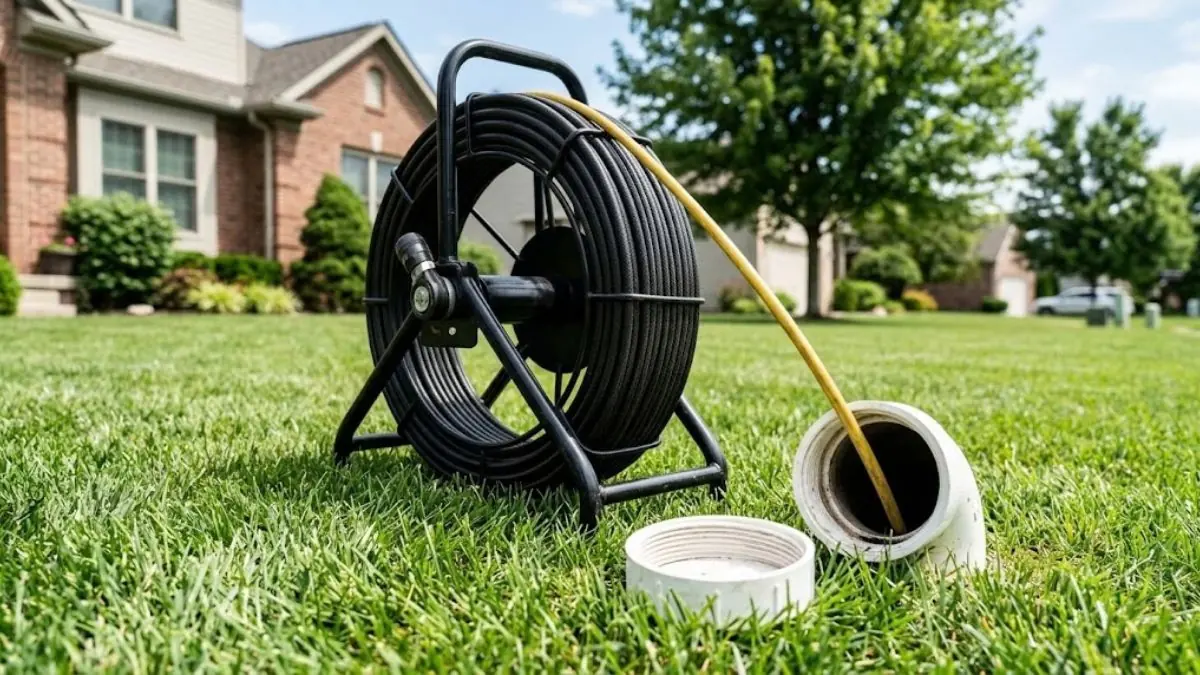
A sewer camera on a push rod shows the material, joints, roots, scale and any sag. Ask for the recording, because you will compare it later.
Keep a simple log
Write the date of every slow drain, gurgle or backup, and which fixtures were affected. Two entries with the same gap tell you the interval.
Set the interval and the trigger
Pick a check date from the table above, plus a trigger sign that moves it forward. Revisit after each cleaning when the camera shows the wall condition.
When cleaning is the wrong answer
If a camera shows a cracked pipe, an offset joint or a belly that holds water, cleaning is a patch. A line that needs clearing more than about twice a year is telling you the pipe has a structural problem.
A cleaning also cannot find a break that is leaking into the soil. The warning is a clean line that still smells, or a wet patch above it. That needs a camera and sometimes locating equipment, not another pass with the cable.
Be careful with renting a cable machine for a main line. A spinning cable can whip, jam in a cleanout or damage old clay. Stop and call a plumber if the cable binds, if sewage is already at floor level, or if you cannot find a cleanout.
Habits that stretch the time between cleanings
Wipes sold as flushable do not break down like paper, and they are a common cause of main line mats. Bin them. Keep grease, coffee grounds and cooking oil out of the kitchen sink, and wipe pans before washing.
Plant large trees and shrubs away from the line, because roots follow moisture to joints. If the lateral was cut by roots once, do not treat it as a one-time event.
Canton, MA: what the town side of the pipe changes
Canton has MWRA sewer service, and the town's 2023 letter says sewer relining is under way in high inflow and infiltration areas. That is work on the public pipe. If several houses on your street back up on the same day, report it to the Canton Water/Sewer Division as well as calling a plumber, because your cleaning will not help a town main.
Canton's Housing Production Plan 2025 says much of the town's housing was built in the mid to late 20th century. A build year does not tell you the pipe material, so a camera is the only way to know whether you have a line that benefits from scheduled cleaning.
Wetlands run along Route 138 in the east and I-95 in the west, and the Neponset forms the town boundary. Where groundwater is high, thaw and heavy rain can push water into cracked joints. If a drain slows only after a storm, tell the plumber, because that pattern points to infiltration rather than buildup.
Sources: Canton Water/Sewer Division 2023 community letter via MWRA (town utility report), Canton Housing Production Plan 2025 (state-hosted planning document, Mass.gov), Town geography notes from Wikipedia and MWRA (reference sources)
Canton, MA questions on this topic
Our street is getting sewer relining. Should I clean my own line?
Not automatically. The relining is on the public main, and your lateral is separate. Ask a plumber for a camera look at your own pipe, and if anything backs up while the work is under way, tell the Canton Water/Sewer Division the same day.
Can I run a rented cable machine on my main line myself?
Clearing a stoppage does not need a permit under 248 CMR 3.05, so the rule is not the obstacle. The risks are a jammed or whipping cable, sewage splashing, and damage to old pipe. Replacing a section of pipe is different. Ask the Canton Building Department about your specific job.
How soon after buying a Canton house should I scope the sewer line?
Before closing if you can, or in the first few weeks. A recorded camera run shows the material, any roots or belly, and whether you should budget for a repair. It also gives you a baseline for later comparison.
Do spring thaws or heavy storms change how often I need cleaning?
They change when problems show, not how often buildup forms. Wet seasons expose cracked joints and push silt into the line. If drains slow right after rain, request a camera visit to look at the joints rather than only clearing the line.
Related services and nearby towns
If you want the line cleared or scheduled for upkeep, our sewer line cleaning page explains cable work and how plumbers pick tools. Greasy or scaled pipe is covered at length where we explain how a high-pressure nozzle scours the wall in a hydro jetting visit.
Neighbors in Randolph and Norwood call the same dispatch line when a main line stops, so you can reach us whichever side of the town border you live on.
Sources and standards
These are the primary sources this page relies on. Anything not listed here is general plumbing practice, and local rules should be confirmed with the town.
- 248 CMR 3.05, the Massachusetts plumbing and gas fitting regulation, as published by Cornell LII
- Town of Canton Building Department, online permitting page (plumbing and gas permits)
- Canton Water/Sewer Division 2023 water quality letter, distributed through the MWRA community page
- Canton Housing Production Plan 2025, published on Mass.gov
- Geography reference for Canton, MA (Wikipedia and MWRA)
Plumbing problem in Canton right now?
Call the 24/7 line. You hear a clear price before work starts.
Call (617) 752-0573