Double Sink Garbage Disposal Plumbing in Canton, MA
By Canton 24/7 Plumbing, 2026
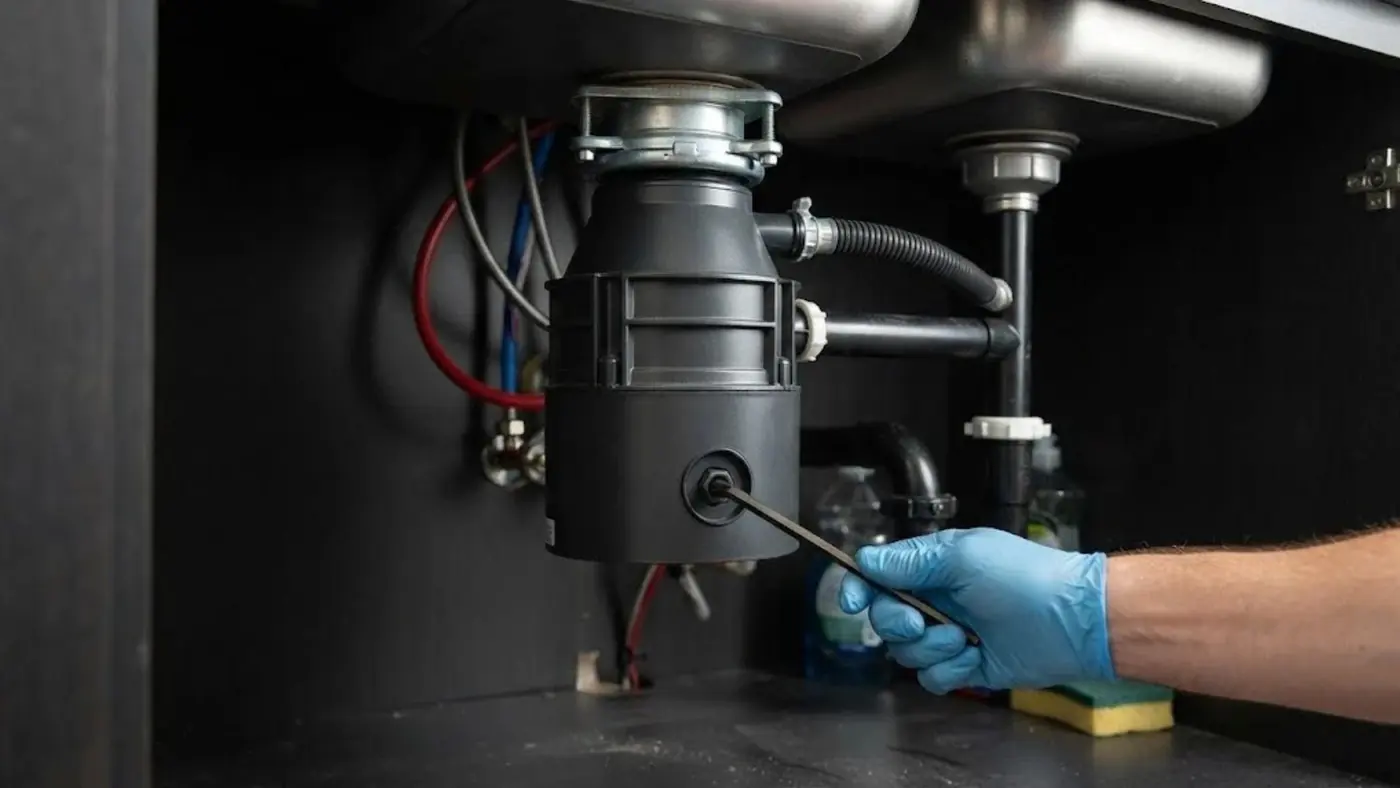
A double kitchen sink with a garbage disposal drains through one shared trap. The disposal bolts under one basin, a short horizontal pipe carries the second basin's water into the disposal outlet, and everything leaves through a single trap and the wall stub. If yours is wired differently, or two traps were installed, that is often why it backs up.
This guide covers the parts, the order they go together, and the mistakes that cause leaks and slow drains in Canton, MA kitchens. It also marks the points where a plumber should take over, such as moving drain lines or anything involving gas or hidden wiring.
The six parts that decide whether it drains
Most trouble comes from a missing or reversed part, not a bad disposal. Check these before you buy anything.
Disposal outlet
A 1.5 inch discharge port on the side of the unit. The horizontal pipe from the second basin connects here.
Continuous waste tee
A fitting that joins the two basins into one line. It must slope toward the wall, never level or back toward the sink.
Basin tailpieces
Straight tubes dropping from each strainer. The non-disposal basin takes a standard 1.5 inch tailpiece.
Dishwasher inlet
A small nipple on the disposal. Its plastic knockout plug must be removed before the dishwasher hose goes on.
P-trap
A single trap sits after the disposal outlet. A second trap on the other basin will gurgle and slow both.
Mounting assembly
The flange, gasket, backup ring and snap ring that hold the unit to the sink. A bad putty seal here drips onto the cabinet floor.
Install order, from the sink down
Switch off the breaker for the disposal circuit first. If the unit is hardwired, confirm the wires are dead with a non-contact voltage tester before you touch them.
Seat the flange
Roll plumber's putty into a rope, press it under the flange lip, and set the flange in the sink opening. Tighten the mounting ring evenly, then wipe off the squeezed-out putty.
Hang the disposal
Attach the unit to the mounting ring, align the discharge port with the drain, and tighten the three mounting screws. Knock out the dishwasher plug now with a screwdriver and hammer, and fish the plug piece out of the chamber.
Connect the second basin
Fit the continuous waste tee on the other basin's tailpiece. Run the horizontal arm to the disposal outlet with slip joints and washers, keeping a slight downward slope toward the wall.
Add the trap
Attach the trap arm below the disposal outlet and the P-trap to the wall stub. Hand-tighten slip nuts and give each a small turn with pliers.
Fill and test
Plug both basins, fill them, release the water and watch every joint with a dry paper towel. Then run the disposal with cold water flowing and check again.
Common layouts and what goes wrong with each
| Layout | What it does | Typical problem |
|---|---|---|
| Disposal on one basin, continuous waste to the other | One shared trap, both basins drain together | Horizontal arm sloped back, water pools and smells |
| Two separate traps tied together under the cabinet | Each basin has its own trap, joined at a wye | Gurgling, one basin slow, extra joints to leak |
| Disposal plus dishwasher on the same outlet | Dishwasher pumps into the disposal inlet | Plug left in, or no high loop, so flows back into the dishwasher |
| Offset drain with a long horizontal run | Wall stub sits far from the sink center | Grease and food settle in the flat section |
The dishwasher connection people get wrong
The dishwasher hose attaches to the disposal's small inlet. If the knockout plug is still in place, dishwasher water backs up into the machine and you find a puddle of gray water in the bottom after a cycle. Remove the plug, fish the piece out, and clamp the hose on.
The hose should rise high under the countertop in a loop before it drops to the disposal. That high loop stops sink water from running back toward the dishwasher. Some kitchens use an air gap on the counter instead. Follow what the dishwasher manual and your plumber specify.
If the dishwasher drain suddenly leaks or backs up, check the hose connection and the disposal inlet before assuming the disposal failed. A pasty blockage at the inlet is common, and garbage disposal repair covers that and jams, hums and leaks.
What you can do yourself and where to stop
Swapping parts on an existing layout is reasonable for a patient homeowner. Changing the layout is plumber work.
Reasonable to DIY
- Replacing a disposal with the same size and mount
- Renewing putty, gaskets and slip washers
- Clearing a trap or the second basin's tailpiece
- Fixing a reversed or sloped-back horizontal arm
Call a licensed plumber for
- Moving the drain stub or adding a new vent
- Cracked or corroded drain pipe inside the wall
- Hardwiring or new circuits if you are unsure of the wiring
- Any gas smell or work near a gas line
Troubleshooting a double sink that still drains slowly
Run one basin and watch the other. If water rises in the second basin while the first drains, the continuous waste is either sloped wrong or partly blocked at the tee. Pull the tee and rinse out any grease collar.
If both basins drain slowly and the disposal hums, remove the trap and look for compacted food. If the trap is clear, the blockage is in the wall stub or farther downstream, and a plumber with a cable machine is the right call. Professional drain cleaning reaches past the trap and is safer than pushing a cable into a disposal chamber.
Never put your hand into the disposal. Use tongs or pliers, and turn the breaker off. To free a jam, use the 1/4 inch hex socket at the bottom of the unit and rotate it back and forth.
Why a second trap is never a good idea
Some old double sinks have a trap under each basin joined downstream. That doubles the joints that can leak, and one trap can siphon the other dry. When you add a disposal, consolidate into one trap on the shared line.
Canton, MA: sewer, septic and permits for a disposal
Canton receives MWRA sewer service, so most kitchens drain to a public sewer rather than a tank. The town does not publish a disposal rule in the sources we used, so ask the Canton Water/Sewer Division if you are unsure. Either way, keep grease out of the disposal.
Canton's online permitting lists a Plumbing Permit, applied for through a ViewPoint Cloud account, with check payment only, and the town does not schedule inspections until a permit is paid in full. Under 248 CMR 3.05, plumbing work needs a permit before it starts, but repairing a leak in a working fixture part or clearing a stoppage does not. Ask the Canton Building Department about your specific job before moving any drain or adding a fixture.
Canton's Housing Production Plan 2025 says about 69 percent of the town's housing is single-family and that much of it was built in the mid to late 20th century. Ask a plumber to look at the wall stub in an older kitchen. If it is rusted through, replace it rather than gluing new plastic to it.
Sources: Town of Canton Online Permitting page (town website), 248 CMR 3.05 as published by Cornell LII (state regulation), Canton Housing Production Plan 2025 (Mass.gov), MWRA customer community page (regional utility)
Canton, MA questions on this topic
Can I add a disposal to a Canton house that is on a septic tank?
First confirm that you have one, since Canton receives MWRA sewer service. If you do, ask your septic professional and the local board of health before adding a disposal, because ground food puts extra solids into the tank. Sharon, for example, is entirely septic and homeowners there are told to follow state Title 5 rules.
Why does the second basin fill when I run the disposal?
Water leaves the disposal and tries to rise through the continuous waste. That happens when the horizontal arm slopes back toward the sink, the tee is clogged with grease, or the trap beyond it is partly blocked. Level the arm first, then clean the tee and trap.
Do I need a permit in Canton to replace a garbage disposal?
A like-for-like swap on the same drain is a repair, but new drain lines, moved fixtures or new gas or venting work are different. 248 CMR 3.05 requires a permit before most plumbing work begins, so ask the Canton Building Department about your specific job.
Can my dishwasher drain into the other basin instead of the disposal?
Some kitchens use a tailpiece fitting with a dishwasher branch instead. It works if a high loop or air gap is in place. Never connect the dishwasher hose below the trap, which can pull sewer gas into the kitchen and let drain water flow backward.
Related services and nearby towns
A disposal that hums, leaks or will not turn is a repair candidate before it is a replacement, and a slow shared drain usually ends with a cable pass through the kitchen line. If you are in a neighboring town on septic, Sharon follows different wastewater rules, while Stoughton calls the same dispatch line as Canton.
Sources and standards
These are the primary sources this page relies on. Anything not listed here is general plumbing practice, and local rules should be confirmed with the town.
- 248 CMR 3.05, the Massachusetts plumbing and gas fitting regulation, as published by Cornell LII
- Town of Canton Building Department, online permitting page (plumbing and gas permits)
- Plumbers and Gas Fitters consumer fact sheet, Massachusetts Board of State Examiners of Plumbers and Gas Fitters
- Canton Water/Sewer Division 2023 water quality letter, distributed through the MWRA community page
- Canton Housing Production Plan 2025, published on Mass.gov
Plumbing problem in Canton right now?
Call the 24/7 line. You hear a clear price before work starts.
Call (617) 752-0573