
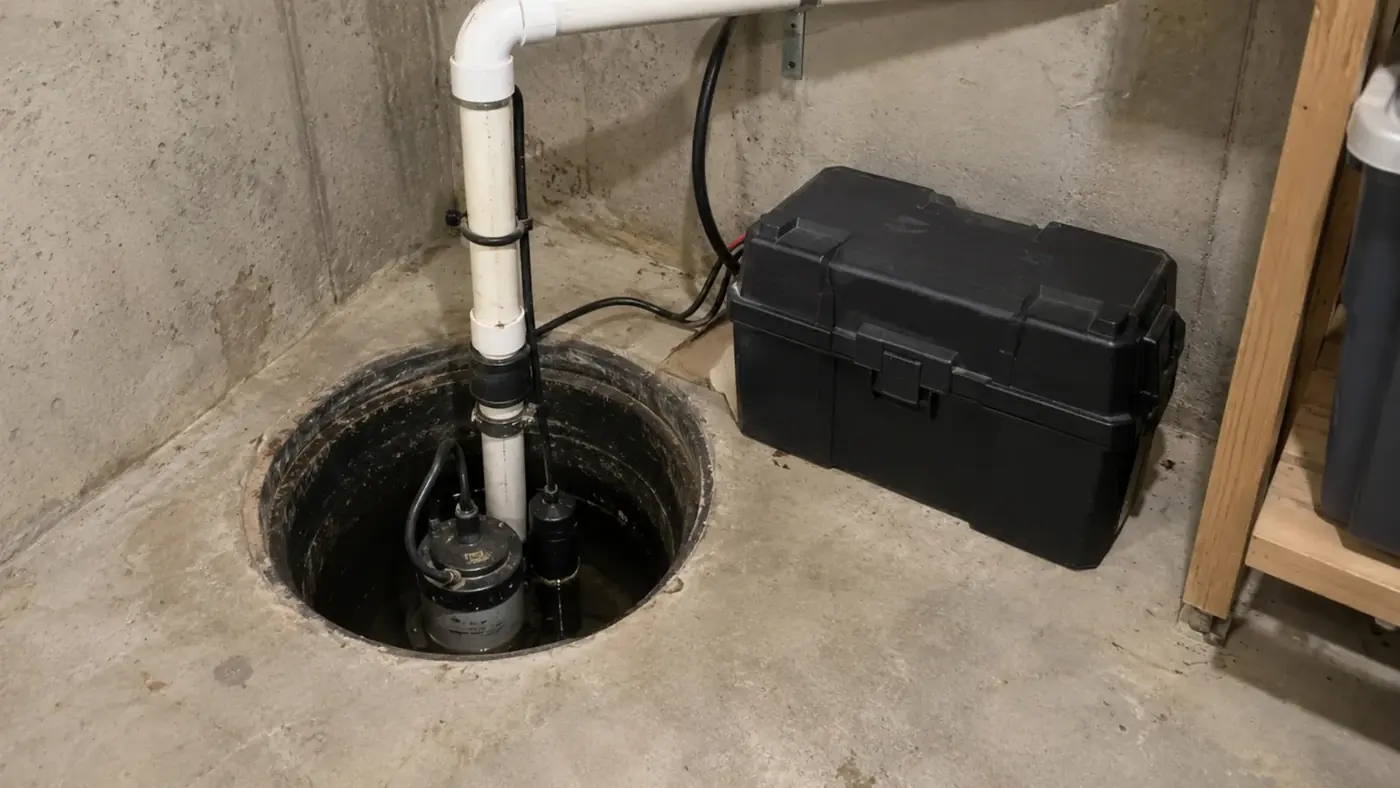
Installing a Backup Sump Pump in Canton, MA
By Canton 24/7 Plumbing, 2026
A backup sump pump is a second pump that takes over when your main pump fails, floods the pit faster than it can empty, or loses power. The usual choice is a battery-powered pump set slightly higher in the same pit, so it switches on only when the water outruns the first pump.
For a Canton, MA basement, the question is not whether the primary pump will ever fail but when, and storms are the time it is most likely to happen. This guide covers the backup types, a realistic installation sequence, electrical safety and the point where you should hand the job to a plumber and an electrician.
Why a single pump is a single point of failure
Most flooded basements with a sump pit lost the pump for one of these reasons, not because the pit was missing.
Power outage
Storms that knock out power also bring the rain, so the pump stops exactly when it is needed.
Stuck float switch
The float jams against the pit wall or debris and never rises, or never drops.
Worn motor
A pump that has run for years burns out under a heavy load, often with no warning.
Clogged intake or check valve
Silt and gravel jam the impeller, or a stuck check valve lets water fall back into the pit.
Backup pump types compared
Each type has a real limit. Match the choice to how your house loses water and how long outages tend to last.
| Type | How it works | Main limit |
|---|---|---|
| Battery backup pump | Second pump on a deep-cycle battery with a charger and alarm | Battery runtime is finite and the battery wears out |
| Water-powered backup | Uses municipal water pressure to drive a jet that pulls water out | Needs town water pressure, uses water, and local rules may restrict it |
| Combination primary and backup unit | Two pumps in one kit with a shared controller | Both are sized to the same pit, so confirm the pit fits |
How a backup pump is installed
This is a typical sequence for a battery system. A plumber follows the same steps, with the electrical parts done safely.
Measure the pit
Check the diameter and depth of the basin. A common pit is 18 inches across, but measure yours, because a second pump has to fit beside the first without jamming either float.
Test the primary pump
Pour a bucket of water into the pit with the pump plugged in. Watch the float rise, the pump start and the water drop. Also check that a check valve sits on the discharge line, because without one the water falls back in.
Set the backup higher
Mount the backup pump so its float triggers a few inches above the primary's. It should start only if the primary fails or cannot keep up.
Run its own discharge line
A separate discharge pipe, commonly 1 1/4 or 1 1/2 inch, with its own check valve keeps the two pumps from working against each other.
Connect battery, charger and alarm
Place the battery on a shelf or plastic tray above the floor, vented as the maker directs. Add a high-water alarm that sounds if the pit rises past both pumps.
Electrical safety around a sump pit
Water and electricity share the same room here, so treat every connection as live until you prove otherwise. Unplug the primary pump before you reach into the pit, and never stand in standing water to work on anything plugged in.
The primary pump should run on a GFCI-protected outlet, ideally a dedicated circuit. A tripped GFCI is a common reason a pump quits, so test the outlet button monthly. If the basement is already wet, do not walk to the panel through water. Call an electrician or your electric utility, and use the 911 line if you smell burning or see sparks.
Wiring a charger, a dedicated circuit or a new outlet is electrician work. A plumber handles the pit, pumps, piping and valves. Splitting the job this way is normal and safer.
Doing part of it yourself or hiring it out
Some of this is within reach for a handy homeowner. Some of it is not.
Reasonable to do yourself
- Testing the pump with a bucket of water
- Cleaning the pit and intake screen
- Adding a plug-in high-water alarm
- Checking the discharge outlet outside
Leave to a pro
- Cutting and gluing the discharge piping
- Installing check valves and unions
- Adding a dedicated electrical circuit
- Deciding where discharge water may legally go
Where the discharge water goes
Point the discharge outdoors, well away from the foundation, so the same water does not sink back into the soil beside the wall and return to the pit. Use a rigid pipe with a splash pad or a buried line that drains downhill.
Do not connect a sump discharge to the sanitary sewer. Clean groundwater in a sewer line adds to inflow and infiltration, and it is generally not allowed. Ask the Canton Water/Sewer Division what applies to your property.
Limits worth stating plainly
A backup pump cannot stop water coming in through the walls or slab. It only moves what reaches the pit. If water shows up on the floor away from the pit, the pit is not the problem, and the longer answer is basement waterproofing, not a bigger pump.
Battery systems give hours of runtime, not days. A long outage with a heavy storm can drain one, so ask your installer to explain the runtime in the real conditions of your house. Insurance often excludes water that seeps in from the ground or backs up through drains unless you have added coverage. Policy wording decides, so read it before the next storm.
A lost pump during active flooding is an emergency. Call (617) 752-0573 and our 24/7 dispatch can send someone. Meanwhile, keep out of any water near outlets or the panel.
Cost factors, not numbers
Price moves with the type of backup, the battery size, the need for new discharge piping, whether the pit has to be enlarged and whether a new electrical circuit is required. A water-powered unit costs less to buy and more to run, because it uses household water.
Ask for an itemized quote that lists both pumps, the check valves, the alarm and the electrical work. For a repair on the pump you already have, see our sump pump repair page. The real price comes from a call.
Canton, MA: the Neponset, the ponds and the wet corridors
Canton sits at the foot of Great Blue Hill, and the Canton River links a chain of ponds, including Bolivar Pond and Forge Pond, before reaching the Neponset River. Wetlands are concentrated along Route 138 in the east and along I-95 in the west. If your house is in or near those corridors, it is reasonable to plan for a pit that runs often, and to ask a plumber to size the backup for that.
New England winters bring freezing weather and nor'easters, and spring thaw and heavy rain load basements. That timing matters for your battery, so test the backup in early spring and again before winter, because storms hit when a stale battery is least reliable.
The sources here do not give groundwater depth for any street in Canton. A plumber can tell you what your own pit does after a heavy rain, and that observation is more reliable than a map.
Sources: Geography and history reference (Wikipedia, MWRA), Canton Water/Sewer Division 2023 community letter (town utility report)
Canton, MA questions on this topic
Do Canton basements near Route 138 or I-95 need a bigger sump pump?
Not automatically. Wetlands lie mainly along Route 138 in the east and I-95 in the west, but your pit's workload depends on your lot and soil. Watch how often the pump runs after rain and ask a plumber to size the pump and backup to that.
How long will a battery backup run?
It depends on the battery, the pump and how fast water enters. A battery may run a few hours of continuous pumping, but far longer if the pump cycles on and off. Ask your installer for a runtime estimate for your pit and test the battery on a schedule.
Can I run my backup off the same outlet as the main pump?
Avoid it. If a tripped GFCI or a bad outlet kills one pump, it should not kill the other. The backup charger and controller need power too, so a separate dedicated circuit is best. An electrician can add one.
Should I connect my sump discharge to the town sewer?
No. Clean groundwater in a sanitary sewer is generally not allowed, because it adds inflow and infiltration the system must treat. Canton's 2023 town letter mentions sewer relining in high inflow and infiltration areas. Ask the Canton Water/Sewer Division about your property.
What should I do when the pit overflows during a storm?
Stay out of standing water if outlets or the panel are wet. Move belongings up, and call a plumber and your insurer. If you smell gas or burning, leave and call 911. Photograph the damage before moving anything.
Related services and nearby towns
A backup pump works best alongside a primary in good shape, and sump pump repair covers that side. For seepage the pit cannot catch, see basement waterproofing. The Neponset also runs along Norwood and Westwood, so homeowners there can read how we serve Norwood and plumbing help in Westwood.
Sources and standards
These are the primary sources this page relies on. Anything not listed here is general plumbing practice, and local rules should be confirmed with the town.
- Canton Water/Sewer Division 2023 water quality letter, distributed through the MWRA community page
- Geography reference for Canton, MA (Wikipedia and MWRA)
Plumbing problem in Canton right now?
Call the 24/7 line. You hear a clear price before work starts.
Call (617) 752-0573